
How It Usually Works: Deconstructing a Media Police Coverup

Media Had Already Bought Police’s Fantasy Version of Walter Scott Killing Before Video Surfaced

By Adam Johnson

FAIR via Alternet

April 8, 2015  – The New York Times (4/7/15 [3]) released a video of a black South Carolina man Walter Scott being shot, casually and without apparent mercy, eight times in the back by white police officer Michael T. Slager. The media’s outrage [4] after the video’s publication was righteous and swift. The state of South Carolina followed suit, filing murder charges [5] against Slager. Indeed, the video offers no ambiguity whatsoever:

Before this shocking video surfaced, however, most of the local press coverage, per usual [6], followed the police’s official narrative and amplified a storyline that, in retrospect, was entirely made up.

The Scott shooting, as Think Progress’s Judd Ledgum pointed out [7], provides unique insight into the way the police use inherent asymmetry of information to assert their narrative:

Between the time when he shot and killed Scott early Saturday morning and when charges were filed, Slager — using the both the police department and his attorney — was able to provide his “version” of the events.

He appeared well on his way to avoiding charges and pinning the blame on Scott.

Then a video, shot by an anonymous bystander, revealed exactly what happened [8].

In all police killings, one side–the victim–is, by definition, dead. So the “both sides” type of reporting we’re so often used to almost invariably becomes a one-sided airing of accounts, facts and selective details from the police side that the corporate media repeats without question. Indeed, Charleston’s local ABC affiliate would begin [9] their report with, what turned out to be, an outright lie:

NORTH CHARLESTON, S.C. (WCIV) — A man involved in a traffic stop that turned into a physical altercation with a North Charleston police officer died Saturday after being shot by the officer.

But the New York Times video shows there was no “physical altercation.” There was someone being shot in the back eight times while trying to run away. The report would go on to mix up police assertion with fact again, seemingly inventing witnesses [10] who weren’t there:

Police and witnesses say Scott tried to run from Slager before turning to fight for the officer’s taser. It was during that scuffle that the officer fired his service weapon, fatally wounding Scott.

But what witnesses? I have asked the reporter, Greg Woods, to name the witnesses he documented; as of press time, he has not responded. Woods did not, in any of his reports, actually quote any witnesses saying they saw a “fight.” What appears to have happened is that Woods was told by police there were witnesses and he reported it, uncritically.

In another piece [11]–that, in fairness, did have interviews with the victim’s family–local CBS affiliate WCSC effectively handed the report over to North Charleston police for their uninterrupted retelling of events:

Slager deployed his taser weapon to detain the driver but was unsuccessful, Pryor said.

Police say an altercation then began between Slager and Scott, resulting in a fight for the officer’s taser.

During the fight, Scott gained control of the taser to use it against the officer who then fired his service weapon at the suspect, Pryor said.

While en route, the sergeant reported that he heard Slager say that he deployed his taser and was requesting for back up units, and seconds later reported “shots fired and the subject is down, he took my taser.”

We now know, by the sheer accident of someone filming the event, this narrative was false. We know Scott never “gained control” of a taser, and we know Scott only received medical attention from police minutes after they planted a weapon on him and handcuffed him as he lay dying. But the media, in an effort to report “both sides,” ends up transcribing the deceptive police report verbatim.

While providing an initial qualifier of “spokesman said,” NBC affiliate News 2, would do one better and go on [12]to drop this modifier altogether and simply report the police account as fact: (Continued)

Continue reading How It Usually Works: Deconstructing a Media Police Coverup
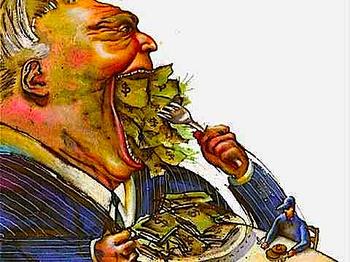
It’s Depressing But True: The Bankers Run the Show

By Ellen Brown
Web of Debt Blog via Alternet

April 8, 2015 – According to a new study from Princeton University [3], American democracy no longer exists. Using data from over 1,800 policy initiatives from 1981 to 2002, researchers Martin Gilens and Benjamin Page concluded [4] that rich, well-connected individuals on the political scene now steer the direction of the country, regardless of – or even against – the will of the majority of voters. America’s political system has transformed from a democracy into an oligarchy, where power is wielded by wealthy elites.

“Making the world safe for democracy” was President Woodrow Wilson’s rationale for World War I, and it has been used to justify American military intervention ever since. Can we justify sending troops into other countries to spread a political system we cannot maintain at home?

The Magna Carta, considered the first Bill of Rights in the Western world, established the rights of nobles as against the king. But the doctrine that “all men are created equal” – that all people have “certain inalienable rights,” including “life, liberty and the pursuit of happiness” – is an American original. And those rights, supposedly insured by the Bill of Rights, have the right to vote at their core. We have the right to vote but the voters’ collective will no longer prevails.

In Greece, the left-wing populist Syriza Party came out of nowhere [5] to take the presidential election by storm; and in Spain, the populist Podemos Party appears poised to do the same. But for over a century, no third-party candidate has had any chance of winning a US presidential election. We have a two-party winner-take-all system, in which our choice is between two candidates, both of whom necessarily cater to big money. It takes big money just to put on the mass media campaigns required to win an election involving 240 million people of voting age.

In state and local elections, third party candidates have sometimes won. In a modest-sized city, candidates can actually influence the vote by going door to door, passing out flyers and bumper stickers, giving local presentations, and getting on local radio and TV. But in a national election, those efforts are easily trumped by the mass media. And local governments too are beholden to big money.

When governments of any size need to borrow money, the megabanks in a position to supply it can generally dictate the terms. Even in Greece, where the populist Syriza Party managed to prevail in January, the anti-austerity platform of the new government is being throttled by the moneylenders who have the government in a chokehold.

How did we lose our democracy? Were the Founding Fathers remiss in leaving something out of the Constitution? Or have we simply gotten too big to be governed by majority vote?

Democracy’s Rise and Fall

The stages of the capture of democracy by big money are traced in a paper called “The Collapse of Democratic Nation States” by theologian and environmentalist Dr. John Cobb. Going back several centuries, he points to the rise of private banking, which usurped the power to create money from governments:

The influence of money was greatly enhanced by the emergence of private banking. The banks are able to create money and so to lend amounts far in excess of their actual wealth. This control of money-creation . . . has given banks overwhelming control over human affairs. In the United States, Wall Street makes most of the truly important decisions that are directly attributed to Washington.

Today the vast majority of the money supply in Western countries is created by private bankers. That tradition goes back to the 17th century, when the privately-owned Bank of England, the mother of all central banks, negotiated the right to print England’s money after Parliament stripped that power from the Crown. When King William needed money to fight a war, he had to borrow. The government as borrower then became servant of the lender. (Continued)

Continue reading It’s Depressing But True: The Bankers Run the Show

Guns, Settlers & Race

Black Panthers made headlines.

By Bill Fletcher, Jr.

Z Communications Daily Commentary

A front page story in the Washington Post struck me. [David A. Fahrenthold, “GOP field backs gun rights with both barrels,” March 29, 2015]  As one would expect, the potential candidates for the Republican presidential nomination are jumping all over themselves to show how ‘pro-gun’ they are.

In the USA we have discussions about guns that pretend to be based in history, but actually miss certain key features. In so doing, the heart and soul of the gun debate is overlooked and the issue devolves into questions of morality and gun safety.

The gun issue in the USA is related to history but not particularly to the 2nd Amendment (the supposed right to bear arms). The debate precedes the 2nd Amendment by more than a century and it revolves around settlers and race.

The gun debate in the USA started in the 1600s and, while there were always matters of safety and hunting, the key question was actually one of who had the right and authority to possess weapons. The second question centered on why the centrality of weapon possession at all.

The settlement of North America, and specifically the original thirteen colonies, was not a non-violent act.  It represented an invasion.  There immediately arose the question of the protection of the invaders, i.e., the colonists.  Thus, weapons, at all costs, had to be kept out of the hands of the indigenous population—the Native Americans or First Nations.  Severe penalties were created for any settler who sold or traded weapons to the Native Americans. This notoriety made its way into the popular media over the years with stories about so-called mavericks who supplied Native Americans with weaponry. During much of the colonial era, and into the 19th century, by the way, this form of activity was frequently associated in the minds of much of the white public with Irish dissidents who were in opposition to the British colonization of Ireland.

Weaponry was also essential for handling an ‘internal’ problem within the emerging settler state:  indentured servants and slaves.  The 1600s was a period of regular uprisings carried out by indentured servants and slaves.  The indentured servant workforce was originally composed of Africans, Europeans and some Native Americans.  It was the turmoil during this period that drove the colonial ruling elite to identify the need to splinter the workforce in order to retain power.  In that context arose the modern usage of “race,” based largely upon the successful experience of the British in the occupation and suppression of the indigenous population in Ireland. (Continued)

Continue reading Guns, Settlers & Race