
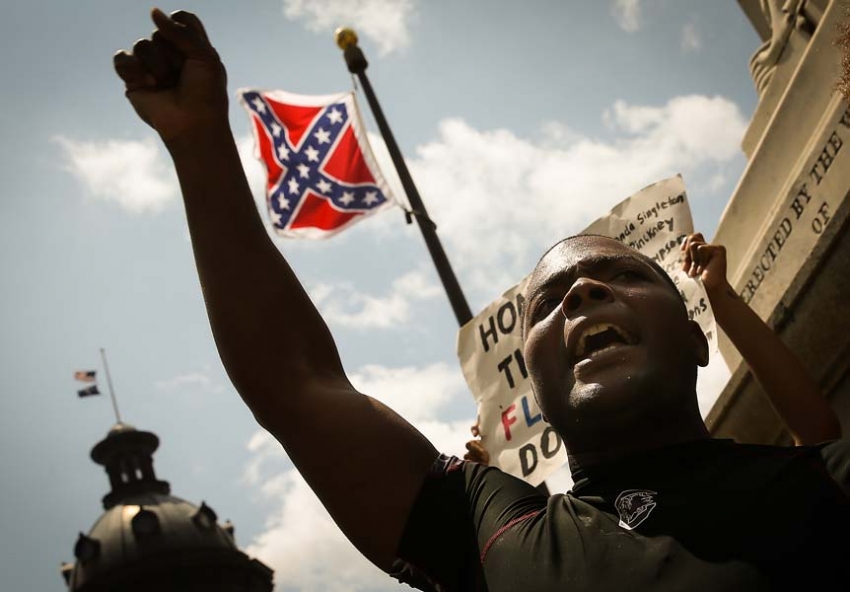
Our Neo-Confederacy

Jalaluddin Abdul Hamid shouts, ‘Take it down!’ in response to a pro-Confederate-flag demonstration outside the South Carolina State House on June 27. (Lexey Swall / Getty Images)

The flag may be wiped from state grounds and license plates, but its ideals live on in the GOP agenda

BY Salim Muwakkil
In These Times

July 8, 2015 – The modern Republican Party—with its voter suppression schemes, states’ rights fetish, and steep cuts to government jobs and services that most benefit black communities—has absorbed the Confederate message.

It is an irony that the symbol of the old Confederacy has become the most prominent victim of the June 17 massacre in Charleston, S.C., rather than the three men and six women who were slaughtered at church.

After photos surfaced of the shooter posing with the flag, a bipartisan chorus of politicians, including at least a dozen Southern Republicans, denounced the flag’s display on state grounds and license plates.

Though the Stars and Bars served as the battle flag for the Confederate Army, it only became a totem of the South in opposition to the integrationist push of the 1950s and 1960s, when it was adopted by the Dixiecrats—Southern Democrats repelled by their party’s embrace of civil rights.

Those disgruntled white Democrats were aggressively recruited by the GOP through Nixon’s Southern Strategy, which was exceedingly successful in transforming the Dixiecrat South into Republican central. Alienated Republican Michael Lofgen, a former staff member of the House and Senate Budget Committee, told MSNBC’s Chris Hayes in 2013 that the GOP has become, in the past few decades, “an insurrectionist, neo-Confederate party.” Or, as Paul Krugman put it in a June 22 column, “Race made Reaganism possible.”

Some see the Tea Party as the latest manifestation of the GOP’s neo-Confederate march. Law professor Ian Haney Lopez, author of Dog Whistle Politics: How Coded Racial Appeals Have Reinvented Racism and Wrecked the Middle Class, argues that the Tea Party’s appeal has much to do with its coded racist messaging. The modern Republican Party—with its voter suppression schemes, states’ rights fetish, and steep cuts to government jobs and services that most benefit black communities—has absorbed the Confederate message. Its platform is in line with the principles espoused by neo-Confederate white separatist groups like the Council of Conservative Citizens, which donated $25,000 to GOP candidates in the last election cycle.

There is little doubt that the ascension of the first black president has contributed to this neo-Confederate boomlet. Obama’s election exacerbated anxiety among America’s white majority about the demographic changes that will, according to the U.S. Census, render it a minority in the next three decades. According to a 2014 Bloomberg poll, most Americans believe black-white “race relations” have worsened since Obama’s election. In its official statement responding to the massacre at Charleston’s Emanuel African Methodist Episcopal Church, the Southern Poverty Law Center (SPLC) noted that racist hate groups are on the rise. The Charleston shooting was “an obvious hate crime by someone who feels threatened by our country’s changing demographics and the increasing prominence of African Americans in public life,” said SPLC President Richard Cohen. The most prominent example is the presence of a black man in the White House.

Every week, it seems we’re presented with new evidence (often videotaped) of ongoing racial turmoil in Obama’s America, incidents so egregious they’ve sparked national protests and given birth to the Black Lives Matter movement. (continued)

Continue reading Our Neo-Confederacy

‘The Face of Racism Today is not a Slaveowner’: Eric Foner on the Past and Present of White Supremacy

South Carolina Is Hardly Alone in Refusing to Confront the Burdens of History, Celebrated Historian Tells Salon

By Elias Isquith
Salon.com

June 24, 2015 – During the past generation or two, the way educated Americans, and especially historians, have come to understand the Civil War and Reconstruction has dramatically changed. Whereas it was once in vogue to play contrarian and argue that the war over slavery — and the subsequent effort to establish true, multiracial pluralist democracies in the South — had little to do with African-American liberation and white supremacy, that is thankfully no longer the case.

While no one, two or three-dozen people can rightly be said to deserve all the credit for this decades-in-the-making shift, few would deny the pivotal role played by Columbia University’s Eric Foner — especially his classic book “Reconstruction: America’s Unfinished Revolution, 1863-1877” as well as the Pulitzer Prize-winning “The Fiery Trial: Abraham Lincoln and American Slavery.” Among others, it was Foner whose top-notch scholarship and unusually engaging prose helped usher in a new understanding of this seminal era that continues to gain influence today.

Recently, Salon reached out to Foner to get his take on the historical roots of the savage attack on Charleston, South Carolina’s, Emanuel African Methodist Episcopal Church. We also discussed Gov. Nikki Haley’s call for the Confederate battle flag to be removed from the state’s Capitol grounds, as well as what it means to say Americans must confront their own history. Our conversation is below and has been edited for clarity and length.

How significant would it be, symbolically, for the Confederate battle flag to be removed by South Carolina?

As you know, and as it has been reported many times, the Confederate flag was only put up on top of the Statehouse in South Carolina in 1962. It was put there as a rebuke to the civil rights movement. It was not a long-standing commemoration of Southern heritage. It was a purely political act to show black people in South Carolina who was in charge.

Symbolism has its limits. On the other hand, to see that flag flying … it’s a statement by South Carolina. Black people perfectly well understand what it stands for. A lot of white people do also. I think removing it is certainly a positive step.

Can you tell me a bit about South Carolina’s history in this regard, and why it’s often singled, out even among its fellow former Confederate states?

I have taught in South Carolina as a visiting professor. I have lectured many times in South Carolina at the University of South Carolina, at Clemson, at Beaufort, in Charleston. I have good friends there and I’m certainly not trying to suggest that everyone in South Carolina is a deep racist or has anything to do with a guy like Dylann Roof. On the other hand, one has to recognize that South Carolina has a very unique and deplorable history when it comes to slavery and race.

It goes way back to the American Revolution. South Carolina had delegates who insisted that Thomas Jefferson take out a clause that condemned slavery from the Declaration of Independence. It was South Carolina delegates who got the Three-Fifths Compromise and the Fugitive Slave Clause into the Constitution. It was South Carolina who was the leader in nullification, the leader in secession. The first shot of the Civil War was shot there. South Carolina was the only Southern state in which the majority of white families owned slaves.

And yet, not incidentally, it also had an unusually large African-American population, too, right?

It had about a 60 percent black population at the time of the Civil War. In other words, the majority of the people in South Carolina were slaves. To say that the Confederate flag represents the heritage of that state is not true; it actually did not represent the majority of South Carolinians even at the time the Confederacy existed. (Continued)

Continue reading ‘The Face of Racism Today is not a Slaveowner’: Eric Foner on the Past and Present of White Supremacy

Charleston Emanuel AME Wasn’t The First


Black church burned in Knoxville, TN

The South’s Sordid History of Attacks on Black Churches

By Chris Kromm
Facing South

June 20, 2015 – In the wake of the heinous murders of nine members of Charleston’s Emanuel African Methodist Episcopal Church this week, many have pointed to historic congregation’s central role in the city’s African-American community.

As Clementa Pinckney, the church’s pastor and state legislator who was killed in the shooting, told a group of visitors in 2013 [1], "It’s a very special place because this site, this area, has been tied to the history and life of African Americans since about the early 1800s."

The massacre called to mind the long history of racially-motivated attacks on black churches in the South, which have been targeted precisely because of their role as not just houses of worship but also sanctuaries from racism and a gathering space for community action.

Sarah Kaplan in The Washington Post [2] looked at Emanuel A.M.E.’s history as a target for racist violence:

It was founded by worshipers fleeing racism and burned to the ground for its connection with a thwarted slave revolt. For years its meetings were conducted in secret to evade laws that banned all-black services. It was jolted by an earthquake in 1886. Civil rights luminaries spoke from its pulpit and led marches from its steps. For nearly two hundred years it had been the site of struggle, resistance and change.

Attacks on black churches continued through the Jim Crow era, and intensified again in the wake of the 1950s civil rights movement. The Sept. 15, 1963 bombing of the 16th Street Baptist Church in Birmingham, Alabama by members of the Ku Klux Klan [3], which killed four girls and injured 20 others, marked a turning point in the escalation of the Southern civil rights struggle.

In the 1990s, black churches again emerged as targets in a wave of arsons and firebombings [4]. As the Institute for Southern Studies reported in its magazine Southern Exposure in 1996 [pdf] [5], fires damaged 230 churches in a 21-month span starting in August 1994, when young white men linked to the neo-Nazi group Aryan Faction threw a Molotov cocktail and shot bullets into a predominantly black church in Clarksville, Tennessee. The assailants left a note, saying, "AF wants you to leave our white community. You Coons! Coon hunting season is open."

As the Southern Exposure investigation found, more than half of the arsons that swept through the South in the mid-1990s involved black churches, even though African-American congregations comprised only a fifth of churches in the region. Eighty percent of those arrested for the fires were white. (Continued)

Continue reading Charleston Emanuel AME Wasn’t The First