Bernie Sanders Draws Blue-Collar Workers in Iowa

Bernie on the picket line in Iowa

By Vaughn Hillyard
Beaver County Blue via NBC News

DES MOINES, Iowa, Sept 7, 2015 — A picketing president? Bernie Sanders said it could be him.

“Yeah, I might. That’s right. Why not,” Sanders said when asked about the possibility after addressing AFSCME union members on Saturday in Altoona, Iowa.

The day before, Sanders picketed outside a Cedar Rapids plant that produces specialized starches alongside union workers engaged in a battle with the plant’s parent company, Ingredion, over new contract negotiations.

And to a crowd of 400 on Thursday in Burlington, Iowa—an old, union town hit hard over the last three decades by shuttered factories—Sanders emphatically stated: “The bottom line is: For millions of American workers, wages in this country are just too damn low.”

Since announcing his candidacy, Sanders has zeroed in on blue-collar voters, consistently addressing low wages, unemployment issues and the country’s trade policies in stump speeches—pushing back against the notion that the economic recovery is as strong as often touted.

“I assumed I would be a Hillary supporter—and rightly or wrongly, probably because I feel like in the last twenty years, the greatest time we had between financial stability was during Bill Clinton’s run,” said Ron Lowe, 52, of Grinnell, Iowa.

But Lowe said he will caucus for Sanders in February. He drove 45 minutes with his mother-in-law last Thursday to see the Democratic candidate at a rally. (Continued)

Continue reading Bernie Sanders Draws Blue-Collar Workers in Iowa
Know Your Battlefield: Taking Stock of the Terrain

What Donald Trump Understands About Republicans

By Thomas B. Edsall
New York Times Op-Ed

Sept 2, 2015 – Donald Trump’s success is no surprise. The public and the press have focused on his defiant rejection of mannerly rhetoric, his putting into words of what others think privately. But the more important truth is that a half-century of Republican policies on race and immigration have made the party the home of an often angry and resentful white constituency — a constituency that is now politically mobilized in the face of demographic upheaval.

Demographic upheaval may be understating it. From 1970 to 2010, the Hispanic population of the United States grew fivefold, from 9.6 million to 50.5 million. From 2000 to 2010, the number of white children under 18 declined by 4.3 million while the number of Hispanic children grew by 4.8 million. In 2013, white children became a minority, 47.7 percent of students ages 3 to 6.

We have become familiar with Trump’s selling point — that he, more than any other Republican candidate, voices nativist and protectionist views in aggressive and abrasive terms, without qualm: “I Love the Mexican people. I do business with the Mexican people, but you have people coming through the border that are from all over. And they’re bad. They’re really bad.” He has vilified Latin American immigrants as “bringing drugs, bringing crime” and as “rapists.”

Not very subtly, Trump conflates American blacks with Mexican immigrants. “I know cities where police are afraid to even talk to people because they want to be able to retire and have their pension,” he declared in Nashville on Aug. 29. “That first night in Baltimore,” when rioting broke out in protest over the death of Freddie Gray in police custody, “they allowed that city to be destroyed. They set it back 35 years in one night because the police weren’t allowed to protect people. We need law and order!”

Urban gangs, in turn, provide Trump with an opportunity to link immigration and crime. “You know a lot of the gangs that you see in Baltimore and in St. Louis and Ferguson and Chicago, do you know they’re illegal immigrants?” Trump vows that after the election, “they’re going to be gone so fast, if I win, that your head will spin.”

1-white-disc

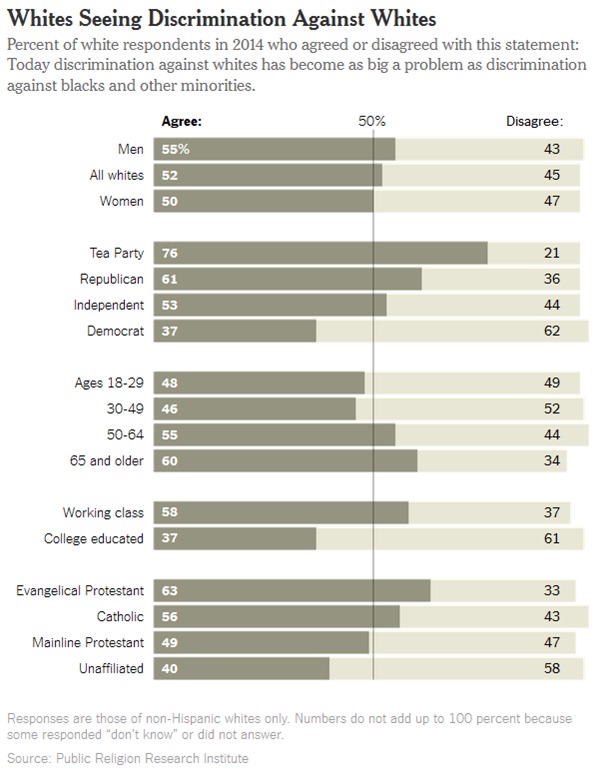
Percent of white respondents in 2014 who agreed or disagreed with this statement: Today discrimination against whites has become as big a problem as discrimination against blacks and other minorities.

The ease with which Trump has grasped top-dog status has provoked apprehension in the Republican establishment –perhaps most vividly in George Will’s comment on the renegade billionaire:

    Every sulfurous belch from the molten interior of the volcanic Trump phenomenon injures the chances of a Republican presidency.

George Will and other traditional conservatives reject the bombastic language Trump favors, preferring a more elliptical approach in order to avoid alienating moderate voters Republicans need to win in 2016. (Continued)

Continue reading Know Your Battlefield: Taking Stock of the Terrain

Why Trump Could Win the GOP Nomination

By Robert Creamer

Huffington Post

Since he entered the GOP contest, most pundits and GOP insiders have treated Trump as a sometimes humorous — sometimes infuriating — distraction from the real race for the Republican nomination.

Now they are beginning to wake up to the fact that Trump is not going away. He is, in fact, a real contender for the nomination. There is no reason whatsoever to believe that a significant portion of his voters will "come to their senses" and withdraw their support from Trump.

In a Public Policy Polling (PPP) poll released August 25, Trump held a commanding lead in the first in the nation New Hampshire primary with 35% of the vote. The establishment candidates, Bush (7%), Walker (7%) and Rubio (6%) don’t even come close. In fact Trump has a lead of 15% on the three of them combined.

A Monmouth University poll showed Trump with a commanding lead of 30% in South Carolina as well.

Trump is not a political clown. He is a very talented right wing populist demagogue. And he has brought into full relief many of the radical policies of the entire GOP field – especially when it comes to immigration.

Trump has seven critical advantages in his campaign for the GOP nomination:

First, his core message is resonant with many GOP voters – especially working class white men. His message is simple: "I will stop them from taking advantage of you."

Remember, most Americans haven’t had a raise in 30 years. All of America’s massive economic growth has gone to the top 1% — people like Trump. Most Americans do believe that someone has been taking advantage of them. Of course Trump doesn’t pin the blame on CEOs, Wall Street banks or big corporations – or on the politicians that have stacked the economic deck in their favor at the expense of ordinary Americans.

Like most right wing populist demagogues before him, he focuses on "the other" – immigrants, and foreign governments – and on the political class in general – whom he positions as incompetent and corrupt.

To make real change he offers a strong man – himself – a man who is not beholden to anyone and can make "real" change.

Second, Trump is credible at delivering that right wing populist message because he can claim that the "establishment" won’t own him, because he doesn’t need their money. He can claim he is free to destroy the status quo, since he won’t owe anyone anything.

Trump understands that many voters, especially frustrated white working class men, don’t care about his "policy proposals" or his "experience" in government. They want a tough son-of-a-bitch who will tear down the establishment that they believe has failed them. And Trump has spent his entire career learning how to behave like a tough son-of-a-bitch. His trade-mark line, after all, is: "your fired."

Continue reading Why Trump Could Win the GOP Nomination