
The Fearful and the Frustrated

Donald Trump’s ‘white nationalist’ coalition takes shape—for now

By Evan Osnos
The New Yorker

Aug 31, 2015 issue – On July 23rd, Donald Trump’s red-white-and-navy-blue Boeing 757 touched down in Laredo, Texas, where the temperature was climbing to a hundred and four degrees. In 1976, the Times introduced Trump, then a little-known builder, to readers as a “publicity shy” wunderkind who “looks ever so much like Robert Redford,” and quoted an admiring observation from the architect Der Scutt: “That Donald, he could sell sand to the Arabs.” Over the years, Trump honed a performer’s ear for the needs of his audience. He starred in “The Apprentice” for fourteen seasons, cultivating a lordly persona and a squint that combined Clint Eastwood on the high plains and Derek Zoolander on the runway. Once he emerged as the early front-runner for the Republican Presidential nomination, this summer, his airport comings and goings posed a delicate staging issue: a rogue wind off the tarmac could render his comb-over fully erect in front of the campaign paparazzi. So, in Laredo, Trump débuted a protective innovation: a baseball hat adorned with a campaign slogan that he recycled from Ronald Reagan’s 1980 run for the White House—“Make America Great Again!” The headwear, which had the rigid façade and the braided rope of a cruise-ship giveaway, added an expeditionary element to the day’s outfit, of blazer, pale slacks, golf shoes—well suited for a mission that he was describing as one of great personal risk. “I may never see you again, but we’re going to do it,” he told Fox News on the eve of the Texas visit.

When Trump announced his candidacy, on June 16th, he vowed to build a two-thousand-mile-long wall to stop Mexico from “sending people that have lots of problems.” He said, “They’re bringing drugs. They’re bringing crime. They’re rapists. And some, I assume, are good people.” Three of the statements had no basis in fact—the crime rate among first-generation immigrants is lower than that for native-born Americans—but Trump takes an expansive view of reality. “I play to people’s fantasies,” he writes in “The Art of the Deal,” his 1987 memoir. “I call it truthful hyperbole. It’s an innocent form of exaggeration—and a very effective form of promotion.”

Trump’s campaign announcement was mocked and condemned—and utterly successful. His favorability among Republicans leaped from sixteen per cent to fifty-seven per cent, a greater spike than that of any other candidate’s début. Immigration became the centerpiece of his campaign. “Donald Trump has changed the entire debate on immigration,” Rush Limbaugh told his listeners last month. As the climax of events in Las Vegas and Phoenix, Trump brought onstage Jamiel Shaw, Sr., whose seventeen-year-old son was killed, in 2008, by a man who was in the country illegally. Trump stood by while Shaw told the crowd how his son was shot.

Before departing for Laredo, Trump said, “I’ve been invited by border patrols, and they want to honor me, actually, thousands and thousands of them, because I’m speaking up.” Though Trump said “border patrols,” the invitation had in fact come from a local branch of the border-patrol union, and the local, after consulting with headquarters, withdrew the invitation a few hours before Trump arrived, on the ground that it would not endorse political candidates. Descending the airplane stairs, Trump looked thrilled to be arriving amid a controversy; he waded into a crowd of reporters and described the change of plans as the handiwork of unspecified enemies. “They invited me, and then, all of a sudden, they were told, silencio! They want silence.” Asked why he felt unsafe in Laredo—which has a lower crime rate than New York City or Washington, D.C.—he invoked another “they”: “Well, they say it’s a great danger, but I have to do it. I love the country. There’s nothing more important than what I’m doing.”

Trump was now going to meet with city officials instead of with the union. He disappeared into one of seven S.U.V.s, escorted by a dozen police vehicles—a larger motorcade than Mitt Romney merited as the Republican nominee. He passed shopping malls, churches, and ranch houses with satellite dishes in the front yard. Some drivers waved; others stared. A car had been positioned along the route with a sign across the windshield: “Mr. Trump, Fuck U.”

He reached the World Trade Bridge, a trucking link to Mexico, where he stepped inside an air-conditioned building for a half-hour briefing. He emerged to talk to reporters, and, after pausing to let the cameras set up, resumed his event. He was asked, “You keep saying that there’s a danger, but crime along the border is down. What danger are you talking about?”

Trump gave a tight, concerned nod. “There’s great danger with the illegals, and we were just discussing that. But we have a tremendous danger along the border, with the illegals coming in.” (Contyinued)
Continue reading The Fearful and the Frustrated

Progressive Democrats of America Bring Movement Pressure to Dems Through Bernie Sanders Campaign

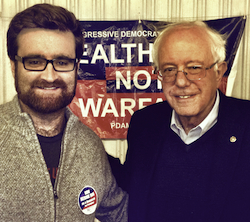
PDA’s Conor Boylan with Bernie Sanders

Thanks to social media campaigns and behind-the-scenes work from the Progressive Democrats of America, Sanders’ chances at president have become a reality.

By Theo Anderson
In These Times

"Bernie is a no-nonsense guy who says what he believes and has legislation to back up what he believes."

July 13, 2015 – In late April, when he announced that he would enter the presidential race, Bernie Sanders was the relatively unknown junior U.S. Senator from Vermont. Now he’s everywhere.

Though the “Sanders surge” seemed to come from nowhere, it was long in the making. Sanders’ rapid rise in the polls, and his increasing visibility over the past few weeks, are in part the result of behind-the-scenes work by organizations like Progressive Democrats of America (PDA).

PDA was founded in 2004 by progressives at the Democratic National Convention who were disappointed with the party’s presidential nominee, John Kerry, but were unwilling to give up on electoral politics. One evening, at the convention’s conclusion, about 200 people met to chart a path forward.

“PDA was founded that night with an inside-outside strategy—to bring outside energy inside the party,” said Conor Boylan, who began working for PDA in 2009 and has been its co-director since 2014. “It was almost an insurgency: We’ll be members of the party, but we’ll also form our own chapters and hold the party accountable.”

PDA now has about 90,000 people on its email list. Of those, about 35,000 members actively support and participate in its work. It is funded by donations from its membership.

In early 2014, PDA began a petition drive to persuade Sanders to run for the presidency. When Sanders attended its tenth anniversary celebration in May of that year, PDA presented him with the petition. That event marked the beginning a strong push by the organization to encourage him to run for the Democratic nomination.

The effort paid off this spring when Sanders announced his candidacy. “We’ve just caught fire since then,” Boylan said. “So it has grown from this small idea—that we have to get Bernie to run—to him actually announcing. And I’m starting to think now that he could actually win this thing. It’s been amazing the way it’s gone the past 15 or 16 months. And where’s it going to end?”

Along with its sister organization, People Demanding Action (which focuses on advancing a policy agenda rather than electoral politics), PDA’s priorities are healthcare reform, campaign finance reform and environmental and economic justice.

House parties are central to PDA’s work. Its website allows people interested in volunteering for the Sanders campaign to sign up to organize a party or find one that’s scheduled near them. PDA sends organizers a kit with information on the basics of hosting a party and assigning people to different tasks, like handing out flyers and maintaining a social media presence. (Continued)

Continue reading Progressive Democrats of America Bring Movement Pressure to Dems Through Bernie Sanders Campaign

The Real Reasons Bernie Sanders is Transforming the Election: Here’s Why He Galvanizes the Left


By Sophia Tesfaye

Salon

July 4, 2015 – CNN dubbed this “the summer of Sanders [3]” as media outlets finally picked up on the large crowds Independent Vermont Senator Bernie Sanders has attracted during campaign stops. His rocketing poll numbers in early primary states like Iowa and New Hampshire led to countless stories heralding a Sanders surge — but the story is as much about the issues as it is about the man.

Even Republican candidates have taken notice of Sanders’ rise. Ahead of a recent stop in Madison, Wisconsin, likely 2016 contender and Wisconsin Governor Scott Walker welcomed Sanders to the state with a series of tweets [4] attacking the democratic socialist once dismissed as too fringe. Walker may not have taken too fondly to Sanders attracting a record 10,000 people in his home state.

But Sanders’ campaign, surely more so than that of any of the Republican candidates, seems to be gaining traction more for the ideas he espouses than because of a cult of personality.

Granted, many supporters have pointed to Sanders’ straightforward manner and willingness to call out bad actors as refreshingly appealing, but unlike with Republican presidential candidates Donald Trump and Chris Christie, it isn’t just a brash style that’s being sold. Sanders makes a direct effort to address many of the issues that have arisen since the Hope & Change campaign of 2008 and it appears as though he is tapping into very real and long-simmering sentiments in the Democratic base.

More than a protest vote against Hillary Clinton, as some have suggested, Sanders’ support appears to be support for issues Clinton’s yet to fully address. Here are some of the ways that Sanders is gaining support by leading on issues or movements that other candidates ignore:

VA Scandal

Sanders was chairman of the Senate Veterans’ Affairs Committee when Democrats last controlled the chamber, and following the VA scandal, Sanders worked with Republicans in the House to pass legislation [5] that expands health care access for veterans and makes it easier to fire underperforming officials.

His record and work on veterans’ affairs issues has earned Sanders top awards from the Veterans of Foreign Wars, the American Legion and the Military Officers Association of America, and now it appears as though that recognition is translating to support for his campaign.

The Boston Globe writes [6] that Sanders’ “surge is partly fueled by veterans,” citing “entire Reddit threads [7] [that] are dedicated to how veterans can best pitch Sanders to other veterans” and “a Facebook page promoting Sanders to veterans.” As the Globe notes, in the early voting state of South Carolina veterans make up about 11 percent of the electorate.

Occupy Wall Street

The short-lived global protest movement suddenly shifted the national debate in the aftermath of the recession from talk of austerity to a focus on growing income inequality by introducing terms like the 1 Percent to national prominence in time for the 2012 campaign. But the Occupy Wall Street movement achieved no great legislative win, and after the encampments were broken down many of the grievances remained unacknowledged, let alone addressed.

Sanders’ 2016 campaign embodies much of the demands of the OWS movement. Speaking to the largest campaign crowd of this cycle [8] in Wisconsin this week, Sanders said, “The big money interests — Wall Street, corporate America, all of these guys — have so much power that no president can defeat them unless there is an organized grassroots movement making them an offer they can’t refuse.” For activists who organized, protested and camped out in Zuccotti Park and squares across America, this message of unfinished business is powerful. The acknowledgement of a continued struggle and willingness to put up a fight is what was galvanized the Draft Warren movement and it has now seemingly shifted to Sanders.

Student Debt Movement

Some Occupy Wall Street activists joined a movement against student debt, which has now surpassed $1 trillion in the U.S. The activists, some of whom had refused to make any more payments on their federal student loans [9], achieved a major victory this year when Corinthian colleges (you know them by their annoying commercials hawking their schools like Everest, Heald and WyoTech) shuttered the last of their remaining U.S. campuses, and the erasure of $13 million in debt. The movement has successfully overseen the closure of campuses in Canada the year before.

Sanders has proposed the College for All Act, [10] a plan to provide tuition-free education at public colleges funded by a small tax on Wall Street transactions. (Continued)

Continue reading The Real Reasons Bernie Sanders is Transforming the Election: Here’s Why He Galvanizes the Left