
Ferguson protesters in Portland seek to build on, learn from Occupy Wall Street movement

Police move forward towards protesters who were marching downtown after flash bang grenades were deployed in Portland during a Ferguson rally on November 29, 2014. Michael Lloyd/The Oregonian

By Anna Griffin

oregonian.com

Protesters who’ve stopped Portland traffic almost daily since a grand jury opted not to indict Darren Wilson began their work back in August. Their goal: to mirror and in some ways build on the Occupy Wall Street movement – but with a more cohesive and ultimately constructive end.

"We’re trying to create something that is going to last," said Teressa Raiford, an organizer of Portland’s Ferguson response rallies. "What you’re seeing is the result of a lot of planning."

Zuccotti Park and the Ferguson, Missouri, street where Wilson shot Michael Brown sit almost 1,000 miles apart. But in terms of their recent impact, they’re practically next-door neighbors.

As they did three years ago, marchers the past week have opted for civil disobedience rather than simply making speeches and rallying in front of Portland civic landmarks. They’ve held "die ins," led police on long, winding marches through downtown, filled Willamette River bridges during rush hour and attempted to seize Interstate 5.

The crowds have included black-clad anarchists and a few Occupy-style protesters in Guy Fawkes masks. The large groups have advocated for a number of causes besides police reform, including a $15 minimum wage, policies to stop gentrification and government disinvestment in multinational corporations. A few of the leading figures in the push to protest the Ferguson decision nationally are the same as Occupy, including Lisa Fithian, who helped put together the 1999 World Trade Organization protests in Seattle and was dubbed "Professor Occupy" by Mother Jones magazine.

"It’s similar in that it’s spreading without any central authority, it’s spreading by inspiration, by a compound of desperation and hope with a little bit of euphoria mixed in," said Todd Gitlin, a journalism professor at Columbia University and author of the 2012 book "Occupy Nation: The Roots, the Spirit and the Promise of Occupy Wall Street." "The big changes made by Occupy were at the level of discourse, making the ‘1 percent’ and ‘the 99 percent’ part of everyday language. The quandary for people angry about Ferguson is how to channel this momentary energy into something that makes changes in more than just the conversation"

At the heart of both movements is an overarching distrust of the nation’s political and economic establishment, a sense that the system does not work for everyone.

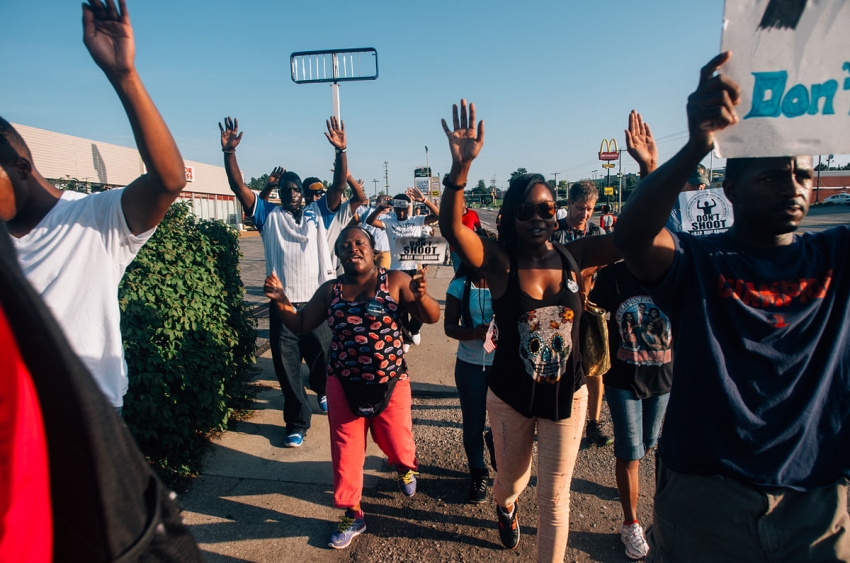
Continue reading Ferguson protesters in Portland seek to build on, learn from Occupy Wall Street movement

CCDS Statement on the Failure of Justice in the Murder of Mike Brown

“Until the killing of Black men, Black mothers’ sons Is as important as the killing of White men, White mothers’ sons”

–Bernice Johnson Reagon

Anger, dismay and tears spread across America last night with the announcement that Officer Darren Wilson got away with murder in Ferguson, MO. A grand jury decision not to bring him to trial was announced on the same day that 3 Civil Rights martyrs – Chaney, Goodman and Schwerner who were murdered 50 years ago this year in Mississippi – received the Medal of Freedom at a White House ceremony with President Obama. Fifty years later, we are still organizing to stop rampant murder of Black people with impunity.

CCDS urges you to join with labor, civil rights, human rights, community and religious organizations who are calling on the U.S. Justice Department to bring federal criminal charges against Officer Darren Wilson.

Please join a protest today and send messages/photos to the CCDS Facebook page at https://www.facebook.com/groups/CCDSGroup/

“We who believe in freedom cannot rest”

Darren Wilson Wasn’t the First: A Short History of Killer Cops Let Off the Hook

Protesters march through the streets of Ferguson. (Jamelle Bouie / Wikimedia Commons)

The U.S. has a long history of allowing police to walk free after vicious racist violence.

BY Flint Taylor

In These Times

Nov 24, 2014 – The pre-ordained failure of a biased local prosecutor to obtain an indictment against Darren Wilson should not surprise us. But the movement for justice for Michael Brown has brought widespread attention to the nationwide problem of systemic and racist police violence and highlighted the movement that has come together to battle against it.

The Ferguson grand jury’s decision not to indict Ferguson police officer Darren Wilson for the killing of African-American teenager Michael Brown is heartless but unsurprising. But it is important to place the case in context with the history of police violence investigations and prosecutions in high profile cases—and the systemic and racist police brutality that continues to plague the nation. In doing so, there are lessons for the movement for justice in the Michael Brown case, as well as for those who are engaged in the broader struggle against law enforcement violence.

What follows, then, is a brief history of similar high profile cases where public outrage compelled the justice system to confront acts of racially motivated police violence—with, to say the least, less than satisfactory results.

Chicago

Over the past 45 years, Chicago has been a prime example of official indifference and cover-up when it comes to prosecuting the police for wanton brutality and torture.

On December 4, 1969, Black Panther leaders Fred Hampton and Mark Clark were slain in a police raid that implicated the Cook County State’s Attorney and the FBI’s Cointelpro program. A public outcry led to a Federal Civil Rights investigation. Despite finding that the raiding police fired more than 90 shots to one by the Panthers, the Grand Jury in 1970 did not indict, but rather issued a report that equally blamed the police perpetrators and the Panther victims.

Outrage at this decision led to the appointment of a Special Prosecutor who, in the face of extreme official resistance, obtained an indictment against the police and the State’s Attorneys who planned and executed the raid—not for murder and attempted murder, but rather for obstruction of justice.

The case came to trial in front of a politically connected judge who dismissed the case without even requiring that the charged officials put on a defense. Again, the outrage, particularly in the African-American community was so extreme that the chief prosecutor, Edward V. Hanrahan, was voted out of office a week after the verdict was rendered in 1972.

Continue reading Darren Wilson Wasn’t the First: A Short History of Killer Cops Let Off the Hook