
Know Your Battlefield: Taking Stock of the Terrain

What Donald Trump Understands About Republicans

By Thomas B. Edsall
New York Times Op-Ed

Sept 2, 2015 – Donald Trump’s success is no surprise. The public and the press have focused on his defiant rejection of mannerly rhetoric, his putting into words of what others think privately. But the more important truth is that a half-century of Republican policies on race and immigration have made the party the home of an often angry and resentful white constituency — a constituency that is now politically mobilized in the face of demographic upheaval.

Demographic upheaval may be understating it. From 1970 to 2010, the Hispanic population of the United States grew fivefold, from 9.6 million to 50.5 million. From 2000 to 2010, the number of white children under 18 declined by 4.3 million while the number of Hispanic children grew by 4.8 million. In 2013, white children became a minority, 47.7 percent of students ages 3 to 6.

We have become familiar with Trump’s selling point — that he, more than any other Republican candidate, voices nativist and protectionist views in aggressive and abrasive terms, without qualm: “I Love the Mexican people. I do business with the Mexican people, but you have people coming through the border that are from all over. And they’re bad. They’re really bad.” He has vilified Latin American immigrants as “bringing drugs, bringing crime” and as “rapists.”

Not very subtly, Trump conflates American blacks with Mexican immigrants. “I know cities where police are afraid to even talk to people because they want to be able to retire and have their pension,” he declared in Nashville on Aug. 29. “That first night in Baltimore,” when rioting broke out in protest over the death of Freddie Gray in police custody, “they allowed that city to be destroyed. They set it back 35 years in one night because the police weren’t allowed to protect people. We need law and order!”

Urban gangs, in turn, provide Trump with an opportunity to link immigration and crime. “You know a lot of the gangs that you see in Baltimore and in St. Louis and Ferguson and Chicago, do you know they’re illegal immigrants?” Trump vows that after the election, “they’re going to be gone so fast, if I win, that your head will spin.”
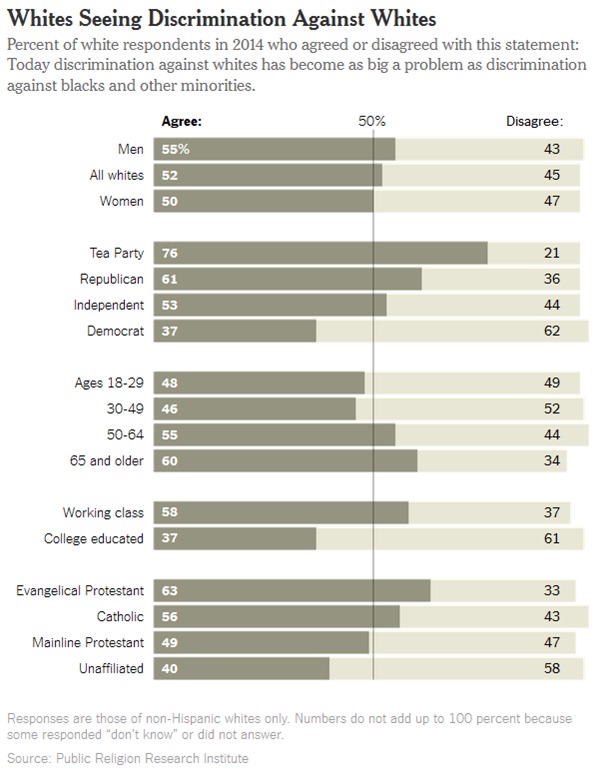
1-white-disc

Percent of white respondents in 2014 who agreed or disagreed with this statement: Today discrimination against whites has become as big a problem as discrimination against blacks and other minorities.

The ease with which Trump has grasped top-dog status has provoked apprehension in the Republican establishment –perhaps most vividly in George Will’s comment on the renegade billionaire:

    Every sulfurous belch from the molten interior of the volcanic Trump phenomenon injures the chances of a Republican presidency.

George Will and other traditional conservatives reject the bombastic language Trump favors, preferring a more elliptical approach in order to avoid alienating moderate voters Republicans need to win in 2016. (Continued)

Continue reading Know Your Battlefield: Taking Stock of the Terrain

Why Trump Could Win the GOP Nomination

By Robert Creamer

Huffington Post

Since he entered the GOP contest, most pundits and GOP insiders have treated Trump as a sometimes humorous — sometimes infuriating — distraction from the real race for the Republican nomination.

Now they are beginning to wake up to the fact that Trump is not going away. He is, in fact, a real contender for the nomination. There is no reason whatsoever to believe that a significant portion of his voters will "come to their senses" and withdraw their support from Trump.

In a Public Policy Polling (PPP) poll released August 25, Trump held a commanding lead in the first in the nation New Hampshire primary with 35% of the vote. The establishment candidates, Bush (7%), Walker (7%) and Rubio (6%) don’t even come close. In fact Trump has a lead of 15% on the three of them combined.

A Monmouth University poll showed Trump with a commanding lead of 30% in South Carolina as well.

Trump is not a political clown. He is a very talented right wing populist demagogue. And he has brought into full relief many of the radical policies of the entire GOP field – especially when it comes to immigration.

Trump has seven critical advantages in his campaign for the GOP nomination:

First, his core message is resonant with many GOP voters – especially working class white men. His message is simple: "I will stop them from taking advantage of you."

Remember, most Americans haven’t had a raise in 30 years. All of America’s massive economic growth has gone to the top 1% — people like Trump. Most Americans do believe that someone has been taking advantage of them. Of course Trump doesn’t pin the blame on CEOs, Wall Street banks or big corporations – or on the politicians that have stacked the economic deck in their favor at the expense of ordinary Americans.

Like most right wing populist demagogues before him, he focuses on "the other" – immigrants, and foreign governments – and on the political class in general – whom he positions as incompetent and corrupt.

To make real change he offers a strong man – himself – a man who is not beholden to anyone and can make "real" change.

Second, Trump is credible at delivering that right wing populist message because he can claim that the "establishment" won’t own him, because he doesn’t need their money. He can claim he is free to destroy the status quo, since he won’t owe anyone anything.

Trump understands that many voters, especially frustrated white working class men, don’t care about his "policy proposals" or his "experience" in government. They want a tough son-of-a-bitch who will tear down the establishment that they believe has failed them. And Trump has spent his entire career learning how to behave like a tough son-of-a-bitch. His trade-mark line, after all, is: "your fired."

Continue reading Why Trump Could Win the GOP Nomination

The Fearful and the Frustrated

Donald Trump’s ‘white nationalist’ coalition takes shape—for now

By Evan Osnos
The New Yorker

Aug 31, 2015 issue – On July 23rd, Donald Trump’s red-white-and-navy-blue Boeing 757 touched down in Laredo, Texas, where the temperature was climbing to a hundred and four degrees. In 1976, the Times introduced Trump, then a little-known builder, to readers as a “publicity shy” wunderkind who “looks ever so much like Robert Redford,” and quoted an admiring observation from the architect Der Scutt: “That Donald, he could sell sand to the Arabs.” Over the years, Trump honed a performer’s ear for the needs of his audience. He starred in “The Apprentice” for fourteen seasons, cultivating a lordly persona and a squint that combined Clint Eastwood on the high plains and Derek Zoolander on the runway. Once he emerged as the early front-runner for the Republican Presidential nomination, this summer, his airport comings and goings posed a delicate staging issue: a rogue wind off the tarmac could render his comb-over fully erect in front of the campaign paparazzi. So, in Laredo, Trump débuted a protective innovation: a baseball hat adorned with a campaign slogan that he recycled from Ronald Reagan’s 1980 run for the White House—“Make America Great Again!” The headwear, which had the rigid façade and the braided rope of a cruise-ship giveaway, added an expeditionary element to the day’s outfit, of blazer, pale slacks, golf shoes—well suited for a mission that he was describing as one of great personal risk. “I may never see you again, but we’re going to do it,” he told Fox News on the eve of the Texas visit.

When Trump announced his candidacy, on June 16th, he vowed to build a two-thousand-mile-long wall to stop Mexico from “sending people that have lots of problems.” He said, “They’re bringing drugs. They’re bringing crime. They’re rapists. And some, I assume, are good people.” Three of the statements had no basis in fact—the crime rate among first-generation immigrants is lower than that for native-born Americans—but Trump takes an expansive view of reality. “I play to people’s fantasies,” he writes in “The Art of the Deal,” his 1987 memoir. “I call it truthful hyperbole. It’s an innocent form of exaggeration—and a very effective form of promotion.”

Trump’s campaign announcement was mocked and condemned—and utterly successful. His favorability among Republicans leaped from sixteen per cent to fifty-seven per cent, a greater spike than that of any other candidate’s début. Immigration became the centerpiece of his campaign. “Donald Trump has changed the entire debate on immigration,” Rush Limbaugh told his listeners last month. As the climax of events in Las Vegas and Phoenix, Trump brought onstage Jamiel Shaw, Sr., whose seventeen-year-old son was killed, in 2008, by a man who was in the country illegally. Trump stood by while Shaw told the crowd how his son was shot.

Before departing for Laredo, Trump said, “I’ve been invited by border patrols, and they want to honor me, actually, thousands and thousands of them, because I’m speaking up.” Though Trump said “border patrols,” the invitation had in fact come from a local branch of the border-patrol union, and the local, after consulting with headquarters, withdrew the invitation a few hours before Trump arrived, on the ground that it would not endorse political candidates. Descending the airplane stairs, Trump looked thrilled to be arriving amid a controversy; he waded into a crowd of reporters and described the change of plans as the handiwork of unspecified enemies. “They invited me, and then, all of a sudden, they were told, silencio! They want silence.” Asked why he felt unsafe in Laredo—which has a lower crime rate than New York City or Washington, D.C.—he invoked another “they”: “Well, they say it’s a great danger, but I have to do it. I love the country. There’s nothing more important than what I’m doing.”

Trump was now going to meet with city officials instead of with the union. He disappeared into one of seven S.U.V.s, escorted by a dozen police vehicles—a larger motorcade than Mitt Romney merited as the Republican nominee. He passed shopping malls, churches, and ranch houses with satellite dishes in the front yard. Some drivers waved; others stared. A car had been positioned along the route with a sign across the windshield: “Mr. Trump, Fuck U.”

He reached the World Trade Bridge, a trucking link to Mexico, where he stepped inside an air-conditioned building for a half-hour briefing. He emerged to talk to reporters, and, after pausing to let the cameras set up, resumed his event. He was asked, “You keep saying that there’s a danger, but crime along the border is down. What danger are you talking about?”

Trump gave a tight, concerned nod. “There’s great danger with the illegals, and we were just discussing that. But we have a tremendous danger along the border, with the illegals coming in.” (Contyinued)

Continue reading The Fearful and the Frustrated