Anti-Racist Organizers Win as Seattle Council Votes to End Youth Incarceration

Young people pressuring city council meeting

By Marcus Harrison Green

Yes! Magazine

Oct 2, 2015 – After a three-year crusade of protest, agitation, and organizing, a Seattle City Council meeting on September 21 brought a major victory to a diverse coalition of youth-prison abolitionists and anti-racist organizers.

“We wouldn’t be here today if it wasn’t for the youth activists.”
In a 9-0 unanimous decision, Seattle’s City Council passed a resolution that fully endorses the goal of zero-percent detention of youth [1], and called for the city to develop policies eliminating the necessity of their imprisonment.

While Council Member Mike O’Brien introduced the resolution in a committee meeting last week, it originated with three organizations that advocate for the abolition of juvenile incarceration: Ending the Prison Industrial Complex (EPIC),  Youth Undoing Institutional Racism (YUIR), and the Seattle branch of the anti-racist organization European Dissent.

“We wouldn’t be here today if it wasn’t for the youth activists,” said Council Member Nick Licata prior to the resolution’s passage. “They’re the ones who created the huge pressure on the county and also the city.”

Seattle’s movement for ending youth incarceration picked up speed after the same city council in 2012 voted overwhelmingly (8-1, with only Kshama Sawant opposed) to fund the replacement of an existing youth detention facility with a new one. What struck organizers at that time was the $210 million poured into the facility.

“I was here the day all except Council Member Sawant voted to build a youth jail with $200 million of our tax money,” asserted white anti-racist organizer James Kahn, addressing the city council. “The movement did not stop after those defeats. The movement could not stop or end until we stop putting children in cages.” (Continued)

Continue reading Anti-Racist Organizers Win as Seattle Council Votes to End Youth Incarceration
The Average American Worker Earns Less Today Than 40 Years Ago

It’s not just unemployment that matters. Many full-time workers take home less money, after inflation, than in decades.


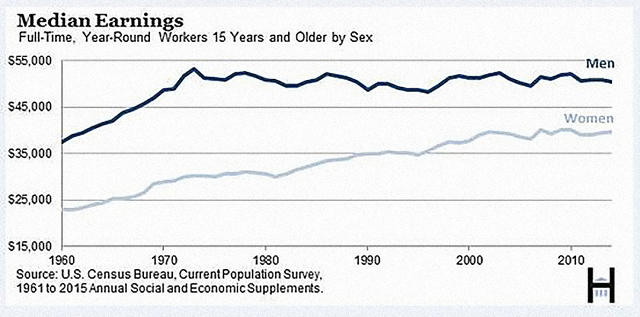
Because most everything we buy gets more expensive over time, we have to earn more money each year just to maintain our existing standard of living. When we’re not given raises that keep up with this rate of inflation, we’re effectively suffering a pay cut.. That’s why many American workers are actually poorer today than four decades ago. They may be earning more money. But, in real terms, they’re getting less for it. Measured in 2014 dollars, the median male full-time worker made $50,383 last year against $53,294 in 1973, according to new U.S. Census Bureau figures.

At $50,383, the figure is the lowest it’s been since 2006. It’s also $450 lower than in 2013. Women have seen bigger increases in real pay in the last few years, though from a lower (unequal) base. The median female worker earned $30,182 in 1973 (in 2014 dollars), but $39,621 last year.

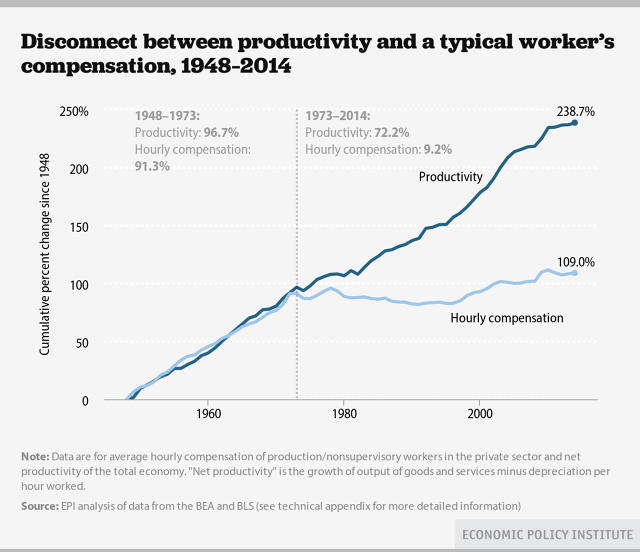
As we explored in our income inequality series recently, technology, globalization, and reduced union bargaining power are all factors behind stagnating wages. The economy has been getting bigger, driven by continuing increases in productivity. But, for one reason or another, workers haven’t been sharing in those gains. But they’re not just disappearing: They’re making a small group of people very, very rich. What are we going to do about that?

[Top Photo: Thomas Barwick/Getty Images]

Meet the Group of African-American Organizers Building Black Support for Bernie Sanders

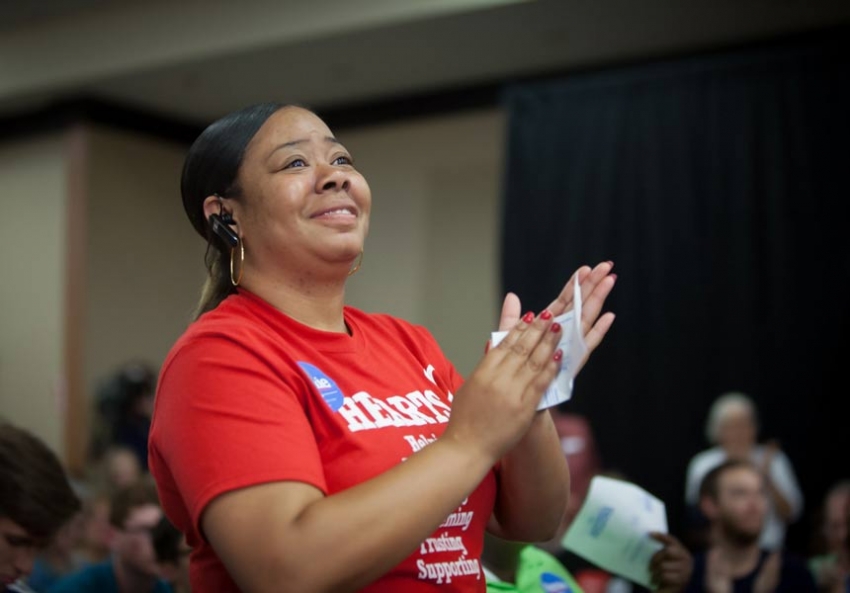
A woman cheers during a Bernie Sanders campaign event on August 21 in Greenville, S.C. (Photo vis Bernie 2016)

Will grassroots organizing within the black electorate be able to challenge Clinton’s hegemony?

By Salim Muwakkil
In These Times

Will Crosby, 63, a veteran political organizer in Chicago’s bruising electoral battles, is worried that the black community will be caught flat-footed in the 2016 presidential campaign.

The way he sees things, too much of the black electorate is sleepwalking in lockstep support of Hillary Clinton. She is by far the black electorate’s favored candidate, with an 80 percent approval rate.

But Crosby thinks Bernie Sanders is the best presidential candidate for African Americans. “Bernie Sanders is talking about issues that directly affect our community and he’s doing it in a fearless way,” Crosby says. Unfortunately, he adds, Sanders’ message has yet to penetrate into the black community.

Crosby and other Chicago-based black activists have formed a group called the Bernie Brigade that attempts to showcase Sanders’ progressive platform and long history of support for the black struggle. The group canvasses for Sanders in majority-black neighborhoods and holds pro-Sanders events. “We’re still very much engaged in an educational process,” he notes. “Many in our community are unfamiliar with Bernie. They just see an elderly white man from remote, white Vermont. And, quite frankly, that’s a hard sell.”

Crosby says attitudes are easily changed when they hear Sanders’ political spiel and his policy prescriptions, especially on reforming the criminal justice system and curbing wealth inequality. But a black electorate that feels warmly toward Clinton may not take the time to listen. According to a CNN poll from June, Sanders had the support of just 2 percent of black Democrats.

The Bernie Brigade is struggling to get political traction in a city still raw from recent hard-fought battles for both Illinois governor and Chicago mayor. The group includes many members who were bitter antagonists in those elections. “If Bernie can bring us together for one cause, I know he can grow his appeal to the larger black community,” Crosby says.

That’s essential for Sanders. As his campaign understands, unless he can ignite the so-called Obama coalition that includes youth, people of color and single women, his likelihood of victory goes from remote to infinitesimal. (Continued)

Continue reading Meet the Group of African-American Organizers Building Black Support for Bernie Sanders