Pittsburgh: Bernie Sanders for President: Yes, He Could!

Pia Colucci, right, of Oakland waits for Bernie Sanders to begin speaking during a telecast broadcasted at a meet-up held in Lawrenceville on Wednesday. Supporters of the Democratic presidential hopeful gathered across the country to watch the telecast. Rebecca Droke/Post-Gazette

By Tony Norman
Pittsburgh Post-Gazette

July 31, 2015 – Vermont Sen. Bernie Sanders has more than a few fans in Pittsburgh, judging by the turnout for his first televised meet-up since his poll numbers began shifting in a positive direction nationally. The muggy Wednesday evening air did its best to discourage a line from forming outside the Spirit Lounge on 51st Street in Lawrenceville, but 350 supporters squeezed into the former Moose Lodge that had once been the home to many a studio ’rasslin’ night.

After ponying up the suggested $5 donation at the door, the cross-generational crowd of Democrats and fellow travelers jockeyed for the best vantage point in front of a projection screen on the east end of the hall. Mr. Sanders would televise his remarks to 3,100 similar gatherings across the country from an apartment in Washington, D.C., shortly after 7 p.m. Eastern time.

According to organizers, Mr. Sanders would be addressing as many as 100,000 supporters nationwide — a number that should concern the complacent Democratic establishment, even though the insurgent candidate trails former Secretary of State Hillary Rodham Clinton by as much as 40 points in some polls.

Still, Bernie Sanders has roughly the same level of name recognition that Sen. Barack Obama had at this point in his underdog campaign against Mrs. Clinton. Unlike Mr. Obama, who was still trying to justify his candidacy to skeptical black leaders already committed to Mrs. Clinton in the summer of 2007, Mr. Sanders is drawing more energetic and enthusiastic crowds than Mrs. Clinton — a sign that the party’s progressive and liberal base is hungry for something it isn’t getting from its presumptive front-runner.

There is still time for Mrs. Clinton to ignite the passion of grass-roots Democrats, of course, but Bernie Sanders is on fire right now in ways no other candidate for the nomination can remotely claim. When he finally appeared on screen to make his speech, there was a collective roar from the crowd that felt almost primal — a mix of sweat, genuine giddiness and exasperation that it has taken so long for a candidate who shares their deepest convictions and disappointment with the status quo to finally emerge.

Technical difficulties with the live stream signal on Pittsburgh’s end prevented him from being heard at first, but when his Brooklyn-forged accent finally broke through the buffering silence, the crowd was primed to hear the candidate declare his allegiance to their issues and priorities.

“The American people are saying loudly and clearly — enough is enough,” Mr. Sanders said after ticking off a series of priorities that would occupy his days in the White House. The candidate would return to this mantra many times after promising to reverse 40 years of middle-class decline and income inequality, raising the minimum wage, affordable college education and combating the “real unemployment rate” he insisted was over 10 percent.

“Maybe, just maybe, instead of higher rates of incarceration,” he said referencing minority youth, “we could provide them with education and jobs.” In a tip-of-the-hat to the #BlackLivesMatter movement that heckled him a week earlier, Mr. Sanders pledged to fight against institutional racism. Just as he was beginning say something about instituting a campaign finance system that didn’t reward corporate bribery, Mr. Sanders’ image froze on the screen, prompting someone in the crowd to shout: “It’s a conspiracy!”

Continue reading Pittsburgh: Bernie Sanders for President: Yes, He Could!
Our Attitude on the Question of Chicago Violence

By Frank Chapman
Field Organizer, Chicago Alliance Against Racist and Political Repression.

Over the July 4th weekend 10 people were killed and 55 wounded. As usual this opened a one-dimensional discussion on “Chicago violence” that focused exclusively on violence in the African American community and “Black on Black Crime”. If a Black person kills a Black person, and particularly if it involves gang rivalry, then that always provides an opportunity for the Mayor, the Anti-Violence Movement and Police Superintendent McCarthy to come out and hold our community in moral contempt for allowing this state of affairs to exist. In fact the Opinion section of the Chicago Sun-Times (July 13, 2015) has an op-ed by Laura Washington that says, “My people are committing genocide”. Raphael Lemkin, an authority on the subject, defined genocide as “a coordinated strategy to destroy a group of people, a process that could be accomplished through total annihilation as well as strategies that eliminate key elements of the group’s basic existence, including language, culture, and economic infrastructure.” So clearly Laura Washington does not understand the gravity of her statement or is unaware of the genocidal policies perpetrated against Black people in America from slavery to the present.

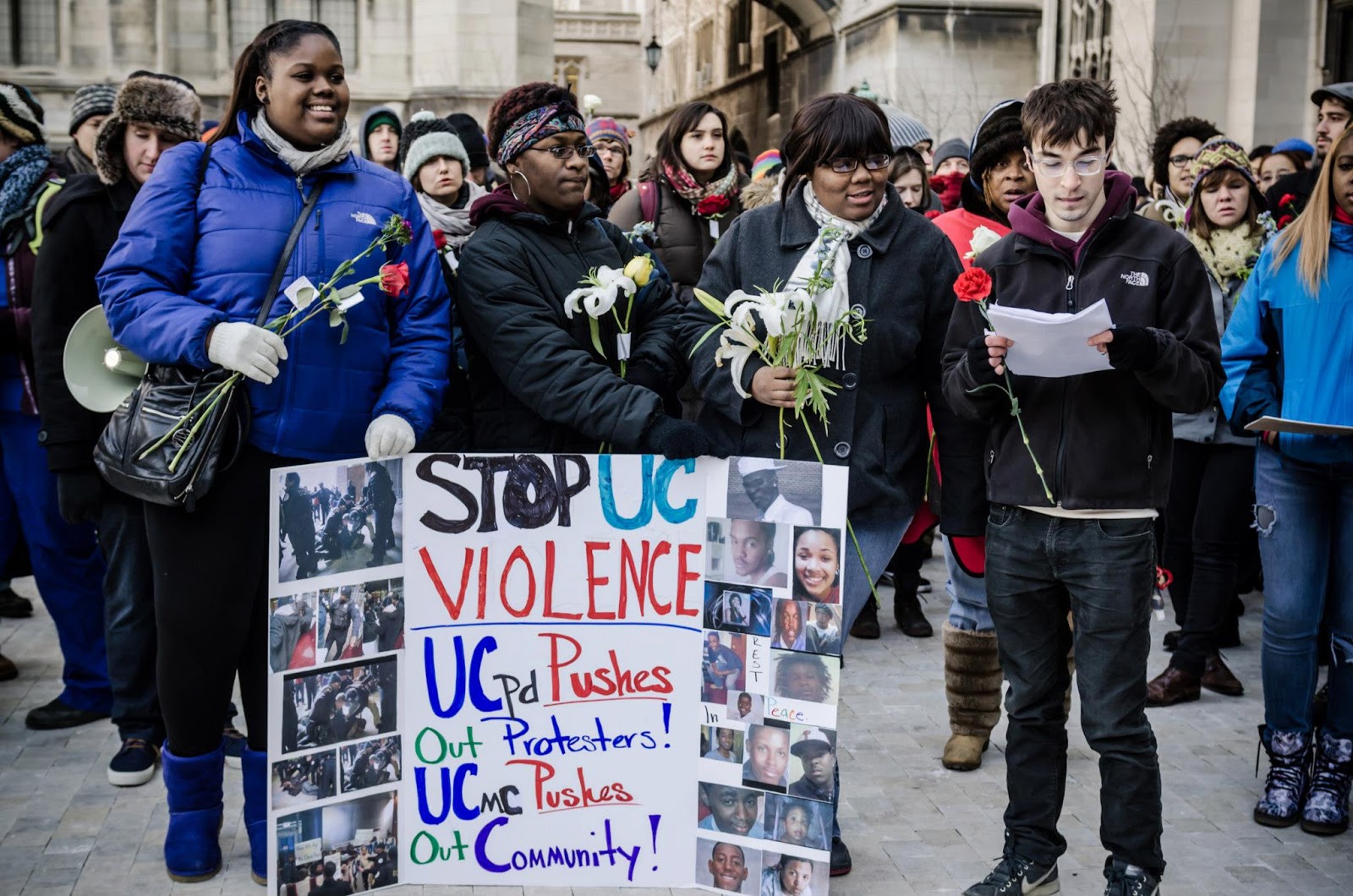
As organizers who are fighting against police crimes and for community control of the police we are constantly challenged by defenders of the status quo to focus on Black on Black crime. How do we respond to that challenge?

First, we start with the objective conditions of oppression in our communities that exist independently of anyone’s opinion. These conditions include high unemployment rates and below poverty wages, massive evictions and foreclosures, inadequate delivery of health services combined with an epidemic of alcohol and drug addiction and high infant mortality rates, miles of dilapidated housing, school closings, and scarce or non-existent recreational facilities. Add to these a phony war on drugs combined with a massive influx of drugs and deadly weapons, mass incarceration, 70% or more of gang related homicides unsolved and the active role of police in some of these murders (never censured, much less prosecuted) , hundreds of innocent victims of police torture and families whose children have been murdered by the police. All of these above-stated conditions are the result of existing government policies (such as austerity programs and institutionalized racist practices) and are the breeding ground for the violence in Chicago focused on by the media. The conditions that breed violence are never honestly discussed by the Mayor and his official and unofficial supporters. In fact, the status quo power relationships in the city are maintained and perpetuated by not addressing the root problems.

The reason why we are agitating, educating and organizing in our communities is because we know that this system of racist injustice that habitually blames the victim is incapable of solving this problem of Chicago violence. We are constantly delivering the message that we must enact an all elected Civilian Police Accountability Council (CPAC) that will hold the police accountable for the crimes they commit and the way they police our communities.

Police crimes and corruption are related to all crimes. That is why when we are petitioning/recruiting in the neighborhoods for CPAC and the response is overwhelmingly “Yes, I’ll sign”! “Yes, I’ll volunteer!”(To date we have about 500 volunteers). We see what the police do every day, and we experience the racist contempt they have for us first hand. The news media, the Mayor, Police Superintendent McCarthy and all their concocted schemes of community policing cannot and have not changed the harsh realities we face on a daily basis.

Finally let me say that the best response to those who would make us responsible for the breeding ground of violence that they created is to continue to build for a Mass March on City Hall this August 29, 2015. On that historic day we must make our voices heard like they have never heard before.

[For more information on the Chicago Alliance Against Racist and Political Repression, see http://naarpr.org .]

__._,_.___

Progressive Democrats of America Bring Movement Pressure to Dems Through Bernie Sanders Campaign

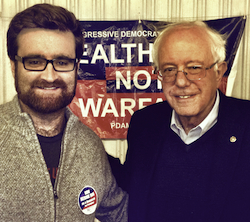
PDA’s Conor Boylan with Bernie Sanders

Thanks to social media campaigns and behind-the-scenes work from the Progressive Democrats of America, Sanders’ chances at president have become a reality.

By Theo Anderson
In These Times

"Bernie is a no-nonsense guy who says what he believes and has legislation to back up what he believes."

July 13, 2015 – In late April, when he announced that he would enter the presidential race, Bernie Sanders was the relatively unknown junior U.S. Senator from Vermont. Now he’s everywhere.

Though the “Sanders surge” seemed to come from nowhere, it was long in the making. Sanders’ rapid rise in the polls, and his increasing visibility over the past few weeks, are in part the result of behind-the-scenes work by organizations like Progressive Democrats of America (PDA).

PDA was founded in 2004 by progressives at the Democratic National Convention who were disappointed with the party’s presidential nominee, John Kerry, but were unwilling to give up on electoral politics. One evening, at the convention’s conclusion, about 200 people met to chart a path forward.

“PDA was founded that night with an inside-outside strategy—to bring outside energy inside the party,” said Conor Boylan, who began working for PDA in 2009 and has been its co-director since 2014. “It was almost an insurgency: We’ll be members of the party, but we’ll also form our own chapters and hold the party accountable.”

PDA now has about 90,000 people on its email list. Of those, about 35,000 members actively support and participate in its work. It is funded by donations from its membership.

In early 2014, PDA began a petition drive to persuade Sanders to run for the presidency. When Sanders attended its tenth anniversary celebration in May of that year, PDA presented him with the petition. That event marked the beginning a strong push by the organization to encourage him to run for the Democratic nomination.

The effort paid off this spring when Sanders announced his candidacy. “We’ve just caught fire since then,” Boylan said. “So it has grown from this small idea—that we have to get Bernie to run—to him actually announcing. And I’m starting to think now that he could actually win this thing. It’s been amazing the way it’s gone the past 15 or 16 months. And where’s it going to end?”

Along with its sister organization, People Demanding Action (which focuses on advancing a policy agenda rather than electoral politics), PDA’s priorities are healthcare reform, campaign finance reform and environmental and economic justice.

House parties are central to PDA’s work. Its website allows people interested in volunteering for the Sanders campaign to sign up to organize a party or find one that’s scheduled near them. PDA sends organizers a kit with information on the basics of hosting a party and assigning people to different tasks, like handing out flyers and maintaining a social media presence. (Continued)

Continue reading Progressive Democrats of America Bring Movement Pressure to Dems Through Bernie Sanders Campaign