
Our Neo-Confederacy

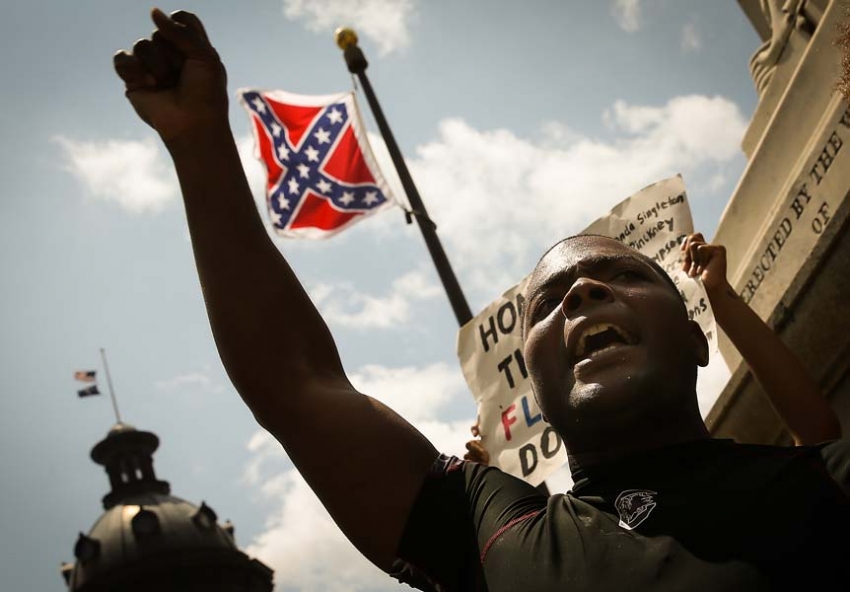
Jalaluddin Abdul Hamid shouts, ‘Take it down!’ in response to a pro-Confederate-flag demonstration outside the South Carolina State House on June 27. (Lexey Swall / Getty Images)

The flag may be wiped from state grounds and license plates, but its ideals live on in the GOP agenda

BY Salim Muwakkil
In These Times

July 8, 2015 – The modern Republican Party—with its voter suppression schemes, states’ rights fetish, and steep cuts to government jobs and services that most benefit black communities—has absorbed the Confederate message.

It is an irony that the symbol of the old Confederacy has become the most prominent victim of the June 17 massacre in Charleston, S.C., rather than the three men and six women who were slaughtered at church.

After photos surfaced of the shooter posing with the flag, a bipartisan chorus of politicians, including at least a dozen Southern Republicans, denounced the flag’s display on state grounds and license plates.

Though the Stars and Bars served as the battle flag for the Confederate Army, it only became a totem of the South in opposition to the integrationist push of the 1950s and 1960s, when it was adopted by the Dixiecrats—Southern Democrats repelled by their party’s embrace of civil rights.

Those disgruntled white Democrats were aggressively recruited by the GOP through Nixon’s Southern Strategy, which was exceedingly successful in transforming the Dixiecrat South into Republican central. Alienated Republican Michael Lofgen, a former staff member of the House and Senate Budget Committee, told MSNBC’s Chris Hayes in 2013 that the GOP has become, in the past few decades, “an insurrectionist, neo-Confederate party.” Or, as Paul Krugman put it in a June 22 column, “Race made Reaganism possible.”

Some see the Tea Party as the latest manifestation of the GOP’s neo-Confederate march. Law professor Ian Haney Lopez, author of Dog Whistle Politics: How Coded Racial Appeals Have Reinvented Racism and Wrecked the Middle Class, argues that the Tea Party’s appeal has much to do with its coded racist messaging. The modern Republican Party—with its voter suppression schemes, states’ rights fetish, and steep cuts to government jobs and services that most benefit black communities—has absorbed the Confederate message. Its platform is in line with the principles espoused by neo-Confederate white separatist groups like the Council of Conservative Citizens, which donated $25,000 to GOP candidates in the last election cycle.

There is little doubt that the ascension of the first black president has contributed to this neo-Confederate boomlet. Obama’s election exacerbated anxiety among America’s white majority about the demographic changes that will, according to the U.S. Census, render it a minority in the next three decades. According to a 2014 Bloomberg poll, most Americans believe black-white “race relations” have worsened since Obama’s election. In its official statement responding to the massacre at Charleston’s Emanuel African Methodist Episcopal Church, the Southern Poverty Law Center (SPLC) noted that racist hate groups are on the rise. The Charleston shooting was “an obvious hate crime by someone who feels threatened by our country’s changing demographics and the increasing prominence of African Americans in public life,” said SPLC President Richard Cohen. The most prominent example is the presence of a black man in the White House.

Every week, it seems we’re presented with new evidence (often videotaped) of ongoing racial turmoil in Obama’s America, incidents so egregious they’ve sparked national protests and given birth to the Black Lives Matter movement. (continued)

Continue reading Our Neo-Confederacy

The Real Reasons Bernie Sanders is Transforming the Election: Here’s Why He Galvanizes the Left


By Sophia Tesfaye

Salon

July 4, 2015 – CNN dubbed this “the summer of Sanders [3]” as media outlets finally picked up on the large crowds Independent Vermont Senator Bernie Sanders has attracted during campaign stops. His rocketing poll numbers in early primary states like Iowa and New Hampshire led to countless stories heralding a Sanders surge — but the story is as much about the issues as it is about the man.

Even Republican candidates have taken notice of Sanders’ rise. Ahead of a recent stop in Madison, Wisconsin, likely 2016 contender and Wisconsin Governor Scott Walker welcomed Sanders to the state with a series of tweets [4] attacking the democratic socialist once dismissed as too fringe. Walker may not have taken too fondly to Sanders attracting a record 10,000 people in his home state.

But Sanders’ campaign, surely more so than that of any of the Republican candidates, seems to be gaining traction more for the ideas he espouses than because of a cult of personality.

Granted, many supporters have pointed to Sanders’ straightforward manner and willingness to call out bad actors as refreshingly appealing, but unlike with Republican presidential candidates Donald Trump and Chris Christie, it isn’t just a brash style that’s being sold. Sanders makes a direct effort to address many of the issues that have arisen since the Hope & Change campaign of 2008 and it appears as though he is tapping into very real and long-simmering sentiments in the Democratic base.

More than a protest vote against Hillary Clinton, as some have suggested, Sanders’ support appears to be support for issues Clinton’s yet to fully address. Here are some of the ways that Sanders is gaining support by leading on issues or movements that other candidates ignore:

VA Scandal

Sanders was chairman of the Senate Veterans’ Affairs Committee when Democrats last controlled the chamber, and following the VA scandal, Sanders worked with Republicans in the House to pass legislation [5] that expands health care access for veterans and makes it easier to fire underperforming officials.

His record and work on veterans’ affairs issues has earned Sanders top awards from the Veterans of Foreign Wars, the American Legion and the Military Officers Association of America, and now it appears as though that recognition is translating to support for his campaign.

The Boston Globe writes [6] that Sanders’ “surge is partly fueled by veterans,” citing “entire Reddit threads [7] [that] are dedicated to how veterans can best pitch Sanders to other veterans” and “a Facebook page promoting Sanders to veterans.” As the Globe notes, in the early voting state of South Carolina veterans make up about 11 percent of the electorate.

Occupy Wall Street

The short-lived global protest movement suddenly shifted the national debate in the aftermath of the recession from talk of austerity to a focus on growing income inequality by introducing terms like the 1 Percent to national prominence in time for the 2012 campaign. But the Occupy Wall Street movement achieved no great legislative win, and after the encampments were broken down many of the grievances remained unacknowledged, let alone addressed.

Sanders’ 2016 campaign embodies much of the demands of the OWS movement. Speaking to the largest campaign crowd of this cycle [8] in Wisconsin this week, Sanders said, “The big money interests — Wall Street, corporate America, all of these guys — have so much power that no president can defeat them unless there is an organized grassroots movement making them an offer they can’t refuse.” For activists who organized, protested and camped out in Zuccotti Park and squares across America, this message of unfinished business is powerful. The acknowledgement of a continued struggle and willingness to put up a fight is what was galvanized the Draft Warren movement and it has now seemingly shifted to Sanders.

Student Debt Movement

Some Occupy Wall Street activists joined a movement against student debt, which has now surpassed $1 trillion in the U.S. The activists, some of whom had refused to make any more payments on their federal student loans [9], achieved a major victory this year when Corinthian colleges (you know them by their annoying commercials hawking their schools like Everest, Heald and WyoTech) shuttered the last of their remaining U.S. campuses, and the erasure of $13 million in debt. The movement has successfully overseen the closure of campuses in Canada the year before.

Sanders has proposed the College for All Act, [10] a plan to provide tuition-free education at public colleges funded by a small tax on Wall Street transactions. (Continued)

Continue reading The Real Reasons Bernie Sanders is Transforming the Election: Here’s Why He Galvanizes the Left

AFL-CIO Leader Tries to Quell pro-Sanders Revolt

The labor federation’s rules don’t allow its state and local leaders to endorse presidential candidates, Richard Trumka says as the Vermont senator surges.

By Brian Mahoney
POLITICO Magazine

July 3, 2010 – Richard Trumka has a message for state and local AFL-CIO leaders tempted to endorse Bernie Sanders: Don’t.

In a memo this week to state, central and area divisions of the labor federation, and obtained by POLITICO, the AFL-CIO chief reminded the groups that its bylaws don’t permit them to “endorse a presidential candidate” or “introduce, consider, debate, or pass resolutions or statements that indicate a preference for one candidate over another.” Even “‘personal’ statements” of candidate preference are verboten, Trumka said.

The memo comes amid signs of a growing split between national union leaders — mindful of the fact that Clinton remains the undisputed favorite for the nomination — and local officials and rank and file, who are increasingly drawn to the Democratic Party’s growing progressive wing, for whom Sanders is the latest standard-bearer.

The South Carolina and Vermont AFL-CIOs have passed resolutions supporting Sanders, and some local AFL-CIO leaders in Iowa want to introduce a resolution at their August convention backing the independent senator from Vermont. More than a thousand labor supporters, including several local AFL-CIO-affiliated leaders, have signed on to “Labor for Bernie,” a group calling on national union leaders to give Sanders a shot at an endorsement.

The AFL-CIO’s constituent unions — as distinct from divisions of the federation itself — remain free to make endorsements however they wish. But they can’t make those endorsements acting through local and regional divisions of the AFL-CIO, as Trumka reminded everyone in the memo.

His message wasn’t anything new for the federation’s state leaders: They know that endorsement decisions belong to the national leadership. Still, it was unusual for Trumka to call them out in a memo. “I’m not sure I’ve ever seen one before like this,” said Jeff Johnson, the president of the AFL-CIO’s Washington state labor council.

Johnson agreed that it was important for the AFL-CIO to speak with a single voice. But “there’s a lot of anxiety out there in the labor movement,” he said, “and we’re desperately searching for a candidate that actually speaks to working-class values. The Elizabeth Warren/Bernie Sanders camp is very, very attractive to many of our members and to many of us as leaders, because they’re talking about the things that need to happen in this country.”

Similarly, Massachusetts AFL-CIO President Steven Tolman said he agreed that Trumka had to lay down the law. More tellingly, though, he added: “Bernie Sanders has spent his life actually fighting for working people. He’s made no secret of it, and he’s used it as his mantra. And that I respect very much.” When asked about Clinton’s candidacy, Tolman was less effusive: “Who? Who? Please. I mean with all respect, huh?”

Other state-level union leaders affiliated with the AFL-CIO didn’t bother to give Trumka and his memo lip service. “I was disappointed by it,” said UPTE-CWA Local 9119 organizing coordinator Lisa Kermish, of Berkeley, California. “I think that local unions and national unions, while it’s important to work together for strength, I think that this is in some ways truncating dialogue. And I find that very unfortunate.” (Continued)

Continue reading AFL-CIO Leader Tries to Quell pro-Sanders Revolt