
Three ‘Yeses’, Three ‘Noes’: China’s Post-Cold War International Policy

China opposes alliance with any other
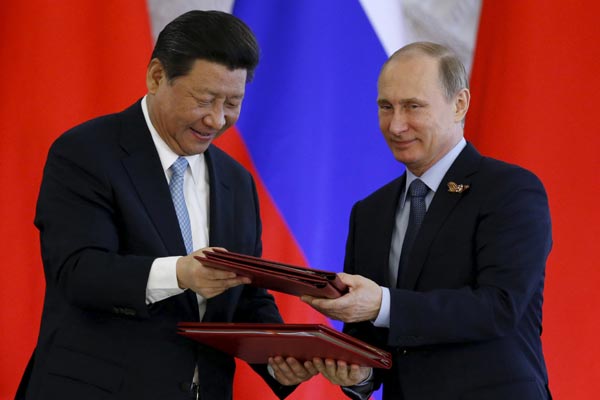
China opposes alliance with any other

Russia’s President Vladimir Putin (R) and China’s President Xi Jinping attend a documents signing ceremony during their meeting at the Kremlin in Moscow, Russia, May 8, 2015. [Photo/Agencies]

By Wu Jianmin

China Daily, May 11, 2015

To say China and Russia are forging a new ideological bloc is simply absurd. The term "ideology" is misleading. What does it mean? No country in the world likes outside interference in its internal affairs, ideology or no ideology.

International law prescribes the principle of non-interference in the internal affairs of another country. And one of the cardinal principles of China’s foreign policy is: No alliance with any other country.

China believes military alliances are a product of the Cold War. With the end of the Cold War, alliances have become obsolete. China used to have a military alliance with the Soviet Union, and it was an unpleasant experience.

In 1978, China adopted a new policy orientation called "reform and opening-up". Since then, China has entered a new period of growth. And its foreign policy is now the extension of its domestic policy. In line with its domestic policy that focuses on economic growth, China has designed a peaceful development strategy for its foreign policy.

What does peaceful development strategy mean? It means three "noes" and three "yeses". The first "no" is no expansion. China will never follow in the footsteps of the former colonial powers. The second is no hegemony. China will never follow the policies of the United States or the Soviet Union. The third is no alliance. China will never enter into a military alliance with any country.

The first "yes" is yes to peace. China has taken a huge undertaking to modernize itself. Peace is the sine qua non for development. The second is yes to development. China faces many problems and believes only development can help solve them. The third is yes to cooperation. China is aware that in a globalized world, no country can modernize itself in isolation. International cooperation is indispensable, and it is because of global cooperation over the past 36 years that China has achieved miraculous economic growth.

President Xi Jinping has been reiterating that China will stick to its peaceful development strategy, and it has no reason to deviate. True, over the past few years, cooperation between China and Russia has deepened on the basis of mutual benefit. But that is because the Chinese and Russian economies are highly complementary. China is a resource-poor country, while Russia is a resource-rich country, and they need each other.

The trade volume between China and Russia reached $95 billion last year, making up about 2 percent of China’s foreign trade. So, there is ample room for further development. Bu China is ready to build cooperation with other countries, too, on the basis of equality and mutual benefit. In this context, the growth of the China-US relationship is a case in point, as their trade volume reached $540 billion last year.

On the Ukraine crisis, China’s consistent position has been that the sovereignty and territorial integrity of every country in the world should be respected. China believes the Ukraine crisis cannot be solved through military means and urges all relevant parties to seek a solution through diplomatic channels.

The author, former president of China Foreign Affairs University, is a member of Berggruen Institute’s 21st Century Council and Foreign Policy Advisory Committee of Chinese Foreign Ministry.

How A Ragtag Group Of Lefties Mainlined Debt-Free College Into The Democratic Primary

Could Progressive Change Campaign Committee help ignite the youth vote for Democrats?

By Sahil Kapur

Bloomberg Politics

May 8, 2015 – A group of two dozen young activists working out of homes and coffee shops around the country has achieved something rather unusual: mainlining an idea into the upper echelons of the Democratic Party—including its top presidential contenders—in just four months.

The phrase "debt-free college" was hardly present in the national political lexicon until the Progressive Change Campaign Committee launched a campaign in January to push Democrats to support the idea of federal assistance to help Americans graduate from college without debt.

Why this idea? The group concluded that the abysmal Democratic turnout in 2014 was due to a lack of bold ideas in the national debate that excited progressives. So it did some polling and found not only strong support but that helping lower the cost of college was the number one issue that would have moved Democratic turnout, said PCCC spokesman TJ Helmstetter. It’s easy to understand younger voters’ interest: Outstanding student loan debt is currently $1.16 trillion and rising, according to the Federal Reserve Bank of New York, averaging $28,400 per college graduate.

"I’m hopeful that debt-free college is the next big idea." –Senator Chuck Schumer

The PCCC partnered with the left-leaning think tank Demos to write a white paper on the idea, which featured three components: federal aid to states to lower tuition costs, federal need-based aid to students, and other patchwork reforms to cut costs such as putting textbooks online.

Then the gears started turning.

In March, the 70-member Congressional Progressive Caucus endorsed debt-free college education in its budget blueprint. On April 21, New York Senator Chuck Schumer, the Democratic leader-in-waiting, cosponsored a resolution embracing the idea with Massachusetts Senator Elizabeth Warren, Hawaii Senator Brian Schatz and the House progressive leaders.

"When it comes to making college affordable, I’m hopeful that debt-free college is the next big idea," Schumer said.

The presidential hopefuls also jumped aboard. On April 13, Vermont Senator Bernie Sanders came out for making four-year public colleges free of tuition. Ten days later former Maryland Governor Martin O’Malley e-mailed supporters to say that Democrats’ "ultimate goal should be simple: every student should be able to go to college debt-free." And this week Democratic frontrunner Hillary Clinton’s campaign manager touted the idea—down to the exact phrase. "What voters are looking for is someone to be a champion for everyday people. For young people, that’s debt-free college," Robby Mook said Wednesday on CNBC.

Outdoing Obama

The plan is more sweeping than recent Democratic proposals. President Barack Obama in March signed a "Student Aid Bill of Rights" to order federal agencies to explore ways to offer students more repayment options and help them better understand their loan plans. On the legislative end, he has proposed two years of free community college, at a cost of $60 billion to the government. Warren has pushed a bill to slash interest rates for undergraduates and post-graduates. Both have gone nowhere in Congress. (Continued)

Continue reading How A Ragtag Group Of Lefties Mainlined Debt-Free College Into The Democratic Primary

Bernie Sanders’s Presidential Bid Represents a Long Tradition of American Socialism

Long deployed by the right as an epithet, this form of left-wing populism is as American as apple pie.

By Peter Dreier
Progressive America Rising via American Prospect

Now that Bernie Sanders has entered the contest for the Democratic Party’s presidential nomination, Americans are going to hearing a lot about socialism, because the 73-year old U.S. senator from Vermont describes himself as a “democratic socialist.”

“Ever since I was a kid I never liked to see people without money or connections get put down or pushed around,” Sanders explained in making his announcement. “When I came to Congress I tried to be a voice for people who did not have a voice—the elderly, the children, the sick, and the poor. And that is what I will be doing as a candidate for president.”

We can expect the right-wing echo chamber—including Fox News hosts, Tea Party politicians, and Rush Limbaugh—to attack Sanders for espousing an ideology that they’ll likely describe as foreign, European, and un-American.

But Sanders’s views are in sync with a longstanding American socialist tradition. Throughout our history, some of the nation’s most influential activists and thinkers, such as Jane Addams, John Dewey, Helen Keller, W.E.B. DuBois, Albert Einstein, Walter Reuther, Martin Luther King, and Gloria Steinem, embraced socialism.  

Of course, America’s right-wingers say there’s already a socialist in the White House. For the past seven years, Barack Obama’s opponents—the Republican Party, the Tea Party, the right-wing blogosphere, , and conservative media gurus like Glenn Beck, Ann Coulter, Bill O’Reilly, Sean Hannity, and Rush Limbaugh—labeled anything Obama proposed, including his modest health-care reforms and his efforts to restore regulations on Wall Street, as “socialism.”

In March 2009, two months after Obama took office, the ultra-conservative National Review put a picture of the new president on its cover over the headline, “Our Socialist Future.” In 2010, Newt Gingrich authored To Save America: Stopping Obama’s Secular-Socialist Machine. Stanley Kurtz, a regular contributor to conservative publications and frequent guest on Fox News, published Radical-in-Chief: Barack Obama and the Untold Story of American Socialism.  These are only a few of the many right-wingers fulminating against Obama’s alleged socialist views.

Obama joked about this in his recent speech at the White House Correspondents’ Association dinner.  “I like Bernie. Bernie’s an interesting guy,” said Obama, referring to Sanders. “Apparently, some folks want to see a pot-smoking socialist in the White House. We could get a third Obama term after all.”

President Franklin Roosevelt faced similar allegations. His conservative enemies, including some members of Congress, consistently called him a socialist. In a speech defending his New Deal goals, FDR said: “A few timid people, who fear progress, will try to give you new and strange names for what we are doing. Sometimes they will call it ‘Fascism’, sometimes ‘Communism’, sometimes ‘Regimentation’, sometimes ‘Socialism’. But, in so doing, they are trying to make very complex and theoretical something that is really very simple and very practical.”  (Continued)

Continue reading Bernie Sanders’s Presidential Bid Represents a Long Tradition of American Socialism