
Baltimore: Race, Class and Uprisings

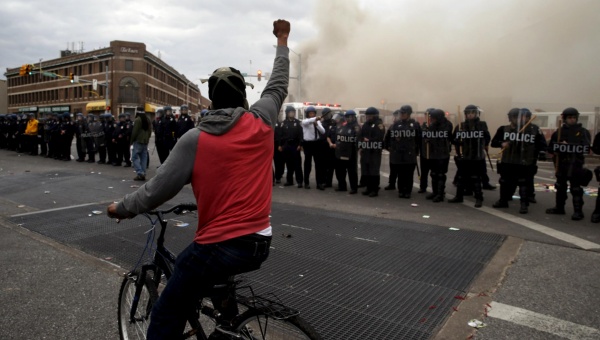
A protester on a bicycle thrusts his fist in the air next to a line of police, in front of a burning CVS drug store, during clashes in Baltimore, Maryland April 27, 2015. This content was originally published by teleSUR at the following address: http:/, Reuters

By Bill Fletcher Jr
TeleSUR via Portside

April 30, 2015 – A broad united front for justice and power, in addition to protesting atrocities, is guided by a sense of hope and a vision of a new day.

It is not enough for us on the Left to comment favorably on the right of oppressed to rebel, to validate the rage that took a very destructive form. Rather, we must support those that engaged in efforts to redirect the rage to preserve their communities as part of a larger movement for justice for Freddie Gray.

A protester on a bicycle thrusts his fist in the air next to a line of police, in front of a burning CVS drug store, during clashes in Baltimore, Maryland April 27, 2015. This content was originally published by teleSUR at the following address: http:/, Reuters,

There was little about the Baltimore uprising following the funeral of the murdered Freddie Gray that surprised me. Tensions had been building ever since word broke that he had died after his spine was severed while in police custody. It was not just that this atrocity had taken place under the most suspicious of circumstances, but that the city government appeared nothing short of anemic in its response.

It did not surprise me that Black youth took to the streets in rage or that there were opportunists within the mobs that took advantage of the strife in order to carry out thefts. It was a riot or uprising. It was not an insurrection and it had neither an ideology nor coherent leadership.

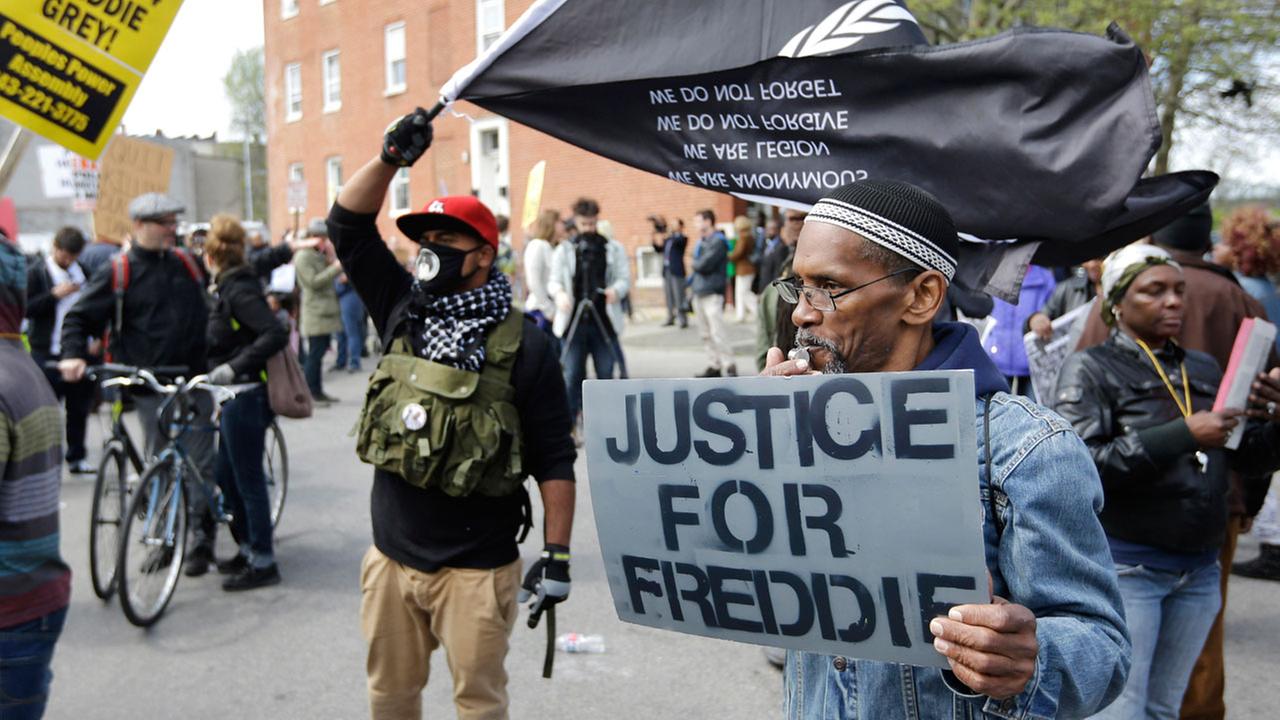
What I found most noteworthy in recent events is something that received limited coverage: the fact that there were organized groupings of men and women who were actively working to redirect the anger of the youth away from the destruction of their neighborhoods. The Nation of Islam, for instance, deployed its members to walk the streets, speak with the youth, and attempt to dissuade them from violence. It was not alone. There were other groups, including gangs as well as ad hoc community groups that set out to both protest the police killing of Freddie Gray but also to try to convince the young rebels that there needed to be a different path. (Continued)
Continue reading Baltimore: Race, Class and Uprisings

Playing the Rightwing Populism Card

Enter Scott Walker, Stage Right

Thomas B. Edsall
Progressive America Rising via New York Times

April 29, 2015 – As Scott Walker has transformed himself from a three-time statewide winner in blue-leaning Wisconsin to a hard-right Republican primary candidate, he has jumped to the head of the pack in Iowa and New Hampshire.

Walker’s re-creation of his political identity is a test of whether a Republican presidential candidate can win on the basis of decisive margins among whites (while getting crushed among minority voters).

Walker hopes to stand apart from Jeb Bush, a former Florida governor, and Marco Rubio, a Florida senator, who are both taking a more centrist approach. Walker intends to stake out the right side of the Republican spectrum and trump competitors for this niche like Senator Ted Cruz of Texas.

Even as he shifts to the right, however, Walker, a preternaturally careful candidate, is avoiding any explicit suggestion that he is the champion of disaffected white voters. Still, key policy positions — particularly his changing stance on immigration and his attacks on public sector unions — reveal a thoughtfully directed appeal. In 2011, Walker successfully sponsored legislation repealing most collective bargaining rights for government employees. Walker’s anti-union initiative has made him a folk hero to conservatives concerned about what they see as the expanding power of government.

In a recent paper, “The Whiteness of Wisconsin’s Wages,” Dylan Bennett, a professor of political science at the University of Wisconsin, and Hannah Walker, a doctoral candidate in political science at the University of Washington, argue that “Governor Walker and his allies activated the racial animus of white workers.”

Bennett and Walker contend that gutting the power of public sector unions serves as a vehicle to disempower African-American workers, “for whom the public sector is the single most important source of employment.” (Continued)

Continue reading Playing the Rightwing Populism Card

Why Baltimore Is Burning

By Kevin Powell
BK Nation

I am from the ghetto. The first 13 years of my life I grew up in the worst slums of Jersey City, New Jersey, my hometown. If you came of age in one of America’s poor inner cities like I did then you know that we are good, decent people: in spite of no money, no resources, little to no services, run down schools, landpersons who only came around to collect rent, and madness and mayhem everywhere, amongst each other, from abusive police officers, and from corrupt politicians and crooked preachers, we still made a way out of no way. We worked hard, we partied hard, we laughed hard, we barbequed hard, we drank hard, we smoked hard, and we praised God, hard.

And we were segregated, hard, by a local power structure that did not want the ghetto to be seen nor heard from, and certainly not to bring its struggles out in plain sight for the world to see.

Indeed my entire world was the block I lived on and maybe five or six blocks north south east west. A long-distance trip was going to Downtown Jersey City on the first of each month so our mothers—our Black and Latina mothers—could cash their welfare checks, buy groceries with their food stamps and, if we were lucky, we got to eat at Kentucky Fried Chicken or some other fast food restaurant on that special day.

When I was about 15 I was badly beaten by a White police officer after me and a Puerto Rican kid had a typical boy fight on the bus. No guns, no knives, just our fists. The Puerto Rican kid, who had White skin to my Black skin, was escorted off the bus gingerly. I was thrown off the bus. Outraged, I said some things to the cop as I sat handcuffed in the back seat of a police car. He proceeded to smash me in the face with the full weight of his fist. Bloodied, terrified, broken in that moment, I would never again view most police officers as we had been taught as children: “Officer Friendly”—

Being poor meant I only was able to go to college because of a full financial aid package to Rutgers University. I did not get on a plane until I was 24-years-old because of that poverty and also because I did not know that was something I could do. These many years later I have visited every single state in America, every city big and small, and every ghetto community you can name. They all look the same.

Abandoned, burnt out buildings. Countless churches, funeral parlors, barber shops, beauty salons, check cashing places, furniture rental stores, fried chicken spots, and Chinese restaurants. Schools that look and feel more like prison holding cells for our youth than centers of learning. Playgrounds littered with broken glass, used condoms, and drug paraphernalia. Liquor stores here there everywhere. Corner stores that sell nothing but candy, cupcakes, potato chips, soda, every kind of beer you can name, loose cigarettes, rolling paper for marijuana, lottery tickets, and gum, lots and lots of gum.

Then there are also the local organizations that claim to serve the people, Black and Latino people. Some mean well, and are doing their best with meager resources. Others only come around when it is time to raise money, to generate some votes for one political candidate or another, or if the police have tragically killed someone. (Continued)

Continue reading Why Baltimore Is Burning