
The Urgent Question of Strategy And Tactics in Building Our Movement

By Frank Chapman

Chicago Alliance Against Racist and Political Repression

How are strategy and tactics determined in waging political struggle? In the historic social movements of the racially oppressed and the working class the question of strategy and tactics is always urgent. To understand why this is important we must look at the basic characteristics that define social movements.

For the purpose of this discussion let us characterize social movements as either spontaneous or organized. Spontaneous social movements arise out of the objective social relations (i.e. social savagery) of capitalism. Driven by profit and greed, the vulture capitalism perpetrated by the 1% creates untold misery and suffering for the masses of workers and oppressed communities of color. Widespread unemployment, poverty and racist and political repression create social unrest and spontaneous rebellion.

These rebellions arise independently of the conscious will of the people expressed through their various organizations such as unions, community based organizations, and organized grass roots political struggles. They have no strategy or tactics. Spontaneous uprisings cannot be stopped or started by organizations. They can be scientifically studied and taken into account in other ways, but they cannot be regulated or determined by subjective evaluation. Unconscious unplanned rebellion takes many forms, even in an uprising as we witnessed in Ferguson. No matter what form it takes, spontaneous rebellion is characteristically blind precisely because it is not guided by an aim or a strategy for liberation.

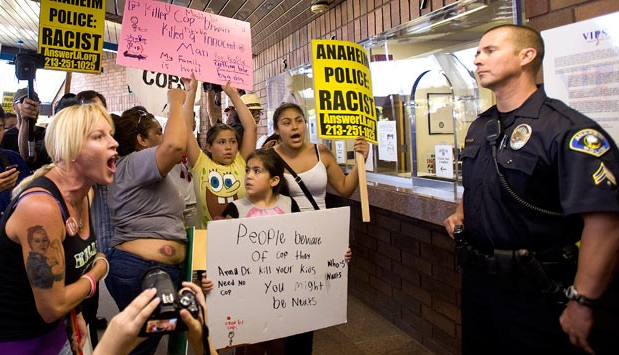
Social movements, on the other hand, become conscious when the people awaken to the need for organized struggle and resistance in fighting their oppressors. That is how social movements transition into conscious organized struggles. Our struggle for an elected Civilian Police Accountability Council (CPAC) represents the conscious, subjective side of the movement in that it is organizing towards a definite goal, the enactment of a law that will empower the people to hold the police accountable for the crimes they commit. This is organized struggle demanding a systemic change that will empower the people to hold the police accountable for the crimes they commit. We fight for power at this stage by making people aware of the systemic nature of the problem and then engaging them in a political struggle to change the system. In this phase of our movement the need for strategy and tactics is urgently clear.

Strategy is determined by scientifically assessing objective social conditions, the moral and political climate and the relationship of forces. The moral and political climate has been dramatically changed by the Ferguson uprising. When we say the police are the cutting edge of mass incarceration and political repression in oppressed communities we are talking about the relationship of forces. You have to be arrested and prosecuted before being sent to prison. Racist police repression, under the cover of draconian drug laws, diminishes the organizing space for people to fight for social and economic justice. We must also look at police repression of the Occupy movement and of the Peace and Solidarity movements. The police will be increasingly used to repress the trade union movement as it grows more militant in organizing the unorganized. We must also acknowledge the repressive role of the FBI and National Security police under the guise of fighting terrorism and keeping our borders safe.

Our strategic goal is community control of the police as it is spelled out in our proposed CPAC legislation. The principal tactic for achieving our goal is organizing a mass support base of voters and residents in those areas hardest hit by police crimes and to organize a mass march of 10,000 to converge on the Federal Building and City Hall August 29, 2015. We already have over 10,000 supporters and some 200 volunteers. Through petitioning, canvassing and reaching out to other community based organizations and movement organizations we believe we can have a total of 100,000 supporters by August 29, 2015 coming mainly out of those communities hardest hit by police crimes.

We believe that this is the most effective way politically and socially to address the distrust and long standing antagonism between oppressed communities of color and the police. The fight for a democratically elected Civilian Police Accountability Council has strategic importance to the overall fight for democracy in our country. Move this spoke, and we move the wheel.

When the Teenager Is the Breadwinner

The Fight for 15 movement could free the children of low-income workers from the need to work after school to keep their families afloat.The Fight for 15 movement could free the children of low-income workers from the need to work after school to keep their families afloat. (Photo: peoplesworld)

…An intersection of race, class and gender

By Yana Kunichoff
In These Times

Jan 5, 2015 – Like many immigrant families, that of Iris Sebastian (a pseudonym) has long played a precarious financial balancing game.

Her parents, Luis and Josefa, both crossed the border from Mexico in the mid-1990s. They met in the U.S. and settled down in Houston, where they had Iris, the oldest of four girls, soon after. Thus began the balancing game. As Luis and Josefa worked low-wage jobs in service or day labor to support themselves and their children, the family was in constant discussion about how to save a little here, a little there. Maybe that meant secondhand clothes or going without new school supplies. Or it could mean a few extra nights of work for Luis or Josefa at their second jobs as cooks.

Working two jobs and trading child care responsibilities sustained them through the boom of the 1990s and even the initial dip of the 2008 recession. From 2005 to 2013, both had steady cook jobs at a Burger King in the Montrose neighborhood of Houston.

That all changed in the fall of 2013. Luis had long suffered from diabetes, and fluid retention in his legs made it increasingly difficult to work on his feet all day, as his service jobs demanded. Eventually he had to severely cut down his working hours. The balancing act became more precarious.

As the oldest daughter, Iris, an 18-year-old high school junior, felt it was her responsibility to keep the family afloat.

“I was telling [my parents] I needed to get a job,” she says . “I always see my mother and she is stressed, I see my dad and his legs are swollen.” She’d tell him, “I know we need money, but I need you to calm down and relax.”

Against the wishes of her family, she, too, took a job. Four or five days a week, Iris works at Smoothie King, a local chain, for the minimum wage of $7.25 an hour.

It’s not uncommon for young people to work. Of the 16.7 million young people aged 16–19 in the United States in November 2014, 28.6 percent were employed and another 20 percent were looking for work, according to the Bureau of Labor Statistics. Similarly, a quarter of Latino youth like Iris are employed.

But what distinguishes Iris is the reason she entered the workforce—economic need. The children of poor families already start off further behind for a slew of reasons, including food insecurity, growing up in a neighborhood without adequate resources, and simply the stress of being poor.  (Continued)

Continue reading When the Teenager Is the Breadwinner

The NYPD’s Mini-Rebellion, and the True Face of American Fascism

By Andrew O’Hehir
Progressive America Rising via Salon

Jan 5, 2015 – In 1935, with Hitler and Mussolini forging a historic alliance in Europe and the world sliding toward war, Sinclair Lewis published the satirical novel “It Can’t Happen Here,”which depicted the rise of an indigenous American fascist movement.

Lewis is a fine prose stylist, but this particular book has an overly melodramatic plot, and is highly specific to its era. It has not aged nearly as well as “Brave New World” or “1984,” and not many people read it today. (At the time, it was understood as an attack on Sen. Huey Longof Louisiana, the populist firebrand who was planning to run against Franklin D. Roosevelt in 1936, but was assassinated before he could do so.)

But certain aspects of Lewis’ fascist America still resonate strongly. His clearest insight came in seeing that the authoritarian impulse runs strong and deep in American society, but that because of our unique political history and our confused national mythology, it must always be called by other names and discussed in other terms.

Oh, yeah — Happy New Year, everybody! Now let’s get back to fascism. When the “Corpo” regime installed by tyrannical President Buzz Windrip in “It Can’t Happen Here” strips Congress of its powers, tries dissidents in secret military courts and arms a repressive paramilitary force called the Minute Men, most citizens go along with it. (Yeah, some of that sounds familiar — we’ll get to that.) These draconian measures are understood as necessary to Windrip’s platform of restoring American greatness and prosperity, and even those who feel uncomfortable with Corpo policies reassure themselves that America is a special place with a special destiny, and that the terrible things that have happened in Germany and Italy and Spain are not possible here. No doubt the irony of Lewis’ title seems embarrassingly obvious now, but it was not meant to be subtle in 1935 either. His point stands: We still comfort ourselves with mystical nostrums about American specialness, even in an age when the secret powers of the United States government, and its insulation from democratic oversight, go far beyond anything Lewis ever imagined.

I’m not the first person to observe that the New York police unions’ current mini-rebellion against Mayor Bill de Blasio carries anti-democratic undertones, and even a faint odor of right-wing coup. Indeed, it feels like an early chapter in a contemporary rewrite of “It Can’t Happen Here”: Police in the nation’s largest city openly disrespect and defy an elected reformist mayor, inspiring a nationwide wave of support from “true patriots” eager to take their country back from the dubious alien forces who have degraded and desecrated it. However you read the proximate issues between the cops and de Blasio (some of which are New York-specific), the police protest rests on the same philosophical foundation as the fascist movement in Lewis’ novel. Indeed, it’s a constant undercurrent in American political life, one that surfaced most recently in the Tea Party rebellion of 2010, and is closely related to the disorder famously anatomized by Richard Hofstadter in his 1964 essay “The Paranoid Style in American Politics.”  (Continued)

Continue reading The NYPD’s Mini-Rebellion, and the True Face of American Fascism