New York Times Assesses Xi Jinping as a Turn to the Left in China

Maoists in China, Given New Life, Attack Dissent

By CHRIS BUCKLEY and ANDREW JACOBS
New York Times

JAN. 4, 2015 – HONG KONG — They pounce on bloggers who dare mock their beloved Chairman Mao. They scour the nation’s classrooms and newspapers for strains of Western-inspired liberal heresies. And they have taken down professors, journalists and others deemed disloyal to Communist Party orthodoxy.

China’s Maoist ideologues are resurgent after languishing in the political desert, buoyed by President Xi Jinping’s traditionalist tilt and emboldened by internal party decrees that have declared open season on Chinese academics, artists and party cadres seen as insufficiently red.

Ideological vigilantes have played a pivotal role in the downfall of Wang Congsheng, a law professor in Beijing who was detained and then suspended from teaching after posting online criticisms of the party. Another target was Wang Yaofeng, a newspaper columnist who voiced support for the recent pro-democracy protests in Hong Kong and then found himself without a job.

“Since Xi came to power, the pressure and control over freethinkers has become really tight,” said Qiao Mu, a Beijing journalism professor who was demoted this fall, in part for publicly espousing multiparty elections and free speech. “More and more of my friends and colleagues are experiencing fear and harassment.”

Two years into a sweeping offensive against dissent, Mr. Xi has been intensifying his focus on perceived ideological opponents, sending ripples through universities, publishing houses and the news media and emboldening hard-liners who have hailed him as a worthy successor to Mao Zedong.

In instructions published last week, Mr. Xi urged universities to “enhance guidance over thinking and keep a tight grip on leading ideological work in higher education,” Xinhua, the official news agency, reported.

In internal decrees, he has been blunter, attacking liberal thinking as a pernicious threat that has contaminated the Communist Party’s ranks, and calling on officials to purge the nation of ideas that run counter to modern China’s Marxist-Leninist foundations.

“Never allow singing to a tune contrary to the party center,” he wrote in comments that began to appear on party and university websites in October. “Never allow eating the Communist Party’s food and then smashing the Communist Party’s cooking pots.” (Continued)

Continue reading New York Times Assesses Xi Jinping as a Turn to the Left in China

Can’t Stop, Won’t Stop: Black Lives Matter Movement Hits Counterreaction

 A crowd of law enforcement officers turn their backs on a screen broadcasting Mayor Bill de Blasio’s remarks from inside the funeral service for Officer Rafael Ramos, outside Christ Tabernacle Church in New York, Dec. 27, 2014. Union officials have attacked the mayor for what they see as insufficient support for the police and excessive sympathy for protesters. (Victor J. Blue/The New York Times)


By Nicholas Powers

Truthout | News Analysis

Jan 2, 2015 – A crowd of law enforcement officers turn their backs on a screen broadcasting Mayor Bill de Blasio’s remarks from inside the funeral service for Officer Rafael Ramos, outside Christ Tabernacle Church in New York, Dec. 27, 2014. Union officials have attacked the mayor for what they see as insufficient support for the police and excessive sympathy for protesters. (Victor J. Blue/The New York Times)

On December 20, a Friday, 28-year-old Ismaaiyl Brinsley eyed a parked NYPD cruiser where Officers Rafael Ramos and Wenjian Liu sat; he pulled out a silver, semiautomatic gun and shot them dead. First and foremost this is a human loss that, like the deaths of Eric Garner and Michael Brown, has left families broken by pain. But quickly their murders were transformed into a political spectacle used by interlocking sectors of the ruling class to delegitimize the Black Lives Matters movement.

Justice will come when the vast majority “sees” that the state, specifically the criminal justice system, is not the cure for crime, but is in part, the cause of it.

On the streets of New York, protesters struggle against the police, conservative media and politicians. Each side fights for the power to shape public opinion. At stake is our social consensus on the limits of the state’s monopoly on violence. The Black Lives Matter movement demands we measure all life equally, which in practice, means sending police who kill innocent black men and women to jail. Whole swaths of reactionary society are lined up against them because they fear a “domino effect” – that if traditional authority is compromised, step by step, we will descend into chaos.

Who wins will determine the very visibility of violence itself. A huge gulf separates the media representation of violence from its lived reality; in that limbo lays the promise or betrayal of justice. It will come when the vast majority “sees” that the state, specifically the criminal justice system, is not the cure for crime, but is in part, the cause of it.

Narrative Visibility

We don’t see with our eyes, but with ideas. Narrative visibility is like a magnifying glass in the brain, it’s the ideological distortion that forces us to “view” some phenomena and be blind to others. Like every city, New York is an imagined community of old-time locals and immigrants, a few rich and the many poor, a boiling metropolis held together, in part, by the story it tells of itself to itself. In the newspapers and TV come endless tales of crime. Some are the hilarious hijinks of passion-addled people. Mostly though, we see the threatening faces of young men of color, tattooed necks and cold eyes. (Continued)

Continue reading Can’t Stop, Won’t Stop: Black Lives Matter Movement Hits Counterreaction

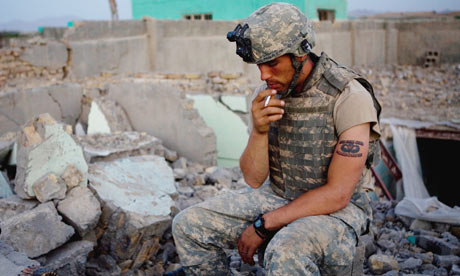
After 13 Years, US-Led Afghanistan War is Officially Over but Nightmare Goes On

The war in Afghanistan claimed the lives of tens of thousands of Afghan civilians and about 3,500 foreign troops

By Deirdre Fulton
Common Dreams

Dec. 28, 2014 – With little fanfare, the United States and NATO formally ended the longest war in U.S. history with a ceremony in Kabul, Afghanistan on Sunday, leaving observers to wonder what—if anything—was achieved.

Over 13 years, U.S.-led war in Afghanistan claimed the lives of about 3,500 foreign troops (at least 2,224 of them American soldiers) and an estimated 21,000 Afghan civilians; most experts agree that the country is as violent as ever and that the death toll will continue to rise. Many say the war is over in name only.

"Afghanistan’s war is as hot as it has been since the U.S.-led invasion following the 9/11 attacks overthrew the Taliban," Lynne O’Donnell writes for the Associated Press. Some 5,000 members of Afghanistan’s security forces—army, police and armed rural defense units—have died this year fighting the Taliban, according to Karl Ake Roghe, the outgoing head of EUPOL, the European Union Police Mission in Afghanistan.

And while the ceremony marked the end of the U.S.-led International Security Assistance Force (ISAF), a new flag for the international mission "Resolute Support" was immediately unfurled.

In late September, the U.S. and Afghanistan signed a controversial Bilateral Security Agreement that allows for U.S. training, funding, and arming of the Afghan military; establishes long-term U.S. military presence in Afghanistan with access to numerous bases and installations in the country; and extends immunity to U.S. service members under Afghan law.

Stars and Stripes set the scene in Kabul: "During an hour-long ceremony in a drab gymnasium at the headquarters of the military coalition that has battled against insurgents for 13 years, generals hailed the end of a mission, while struggling to explain the parameters of what will still be a substantial military operation in Afghanistan."

There will still be roughly 11,000 American troops in Afghanistan next year as part of the Resolute Support mission to train, advise and assist Afghanistan’s roughly 350,000 security forces. ISAF spokesman Lt. Col. Christopher Belcher told Stars and Stripes that there would be a total of roughly 17,500 foreign troops in Afghanistan next year, which the publication notes is "far more than the 12,000-13,000 U.S. and NATO officials have been saying would be part of Resolute Support. Belcher could not say where those additional troops would be coming from nor when or why the decision was made to increase their number."

Continue reading After 13 Years, US-Led Afghanistan War is Officially Over but Nightmare Goes On