Blood On Their Hands: The Racist History of Modern Police Unions

By Flint Taylor
In These Times

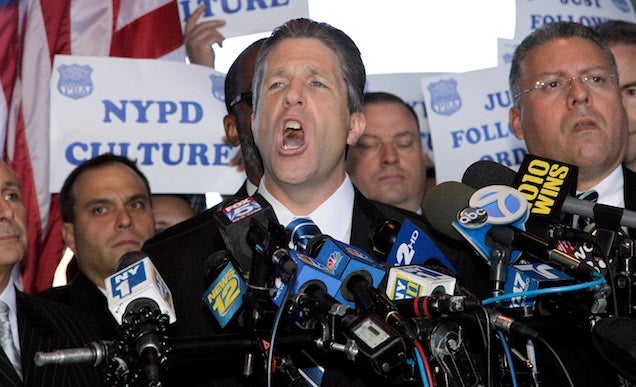
Jan 14, 2015 – Outraged by New York City Mayor Bill de Blasio’s statements concerning the killing of Eric Garner, Patrick Lynch, the longtime leader of the New York City Patrolmen’s Benevolent Association (PBA), the NYPD’s officers union, recently made the outrageous assertion that the Mayor had “blood on his hands” for the murder of the two NYPD officers.

In Milwaukee this past fall, the Police Association called for, and obtained, a vote of no confidence in MPD Chief Ed Flynn after he fired the officer who shot and killed Dontre Hamilton, an unarmed African American; subsequently, the union’s leader, Mike Crivello, praised the District Attorney when he announced that he would not bring charges against the officer.

In Chicago, the Fraternal Order of Police (FOP), a longtime supporter of racist police torturer Jon Burge, is now seeking to circumvent court orders that preserve and make public the police misconduct files of repeater cops such as Burge, by seeking to enforce a police contract provision that calls for the destruction of the files after seven years.  And in a show of solidarity with the killer of Michael Brown, Chicago’s FOP is soliciting contributions to the Darren Wilson defense fund on its website.

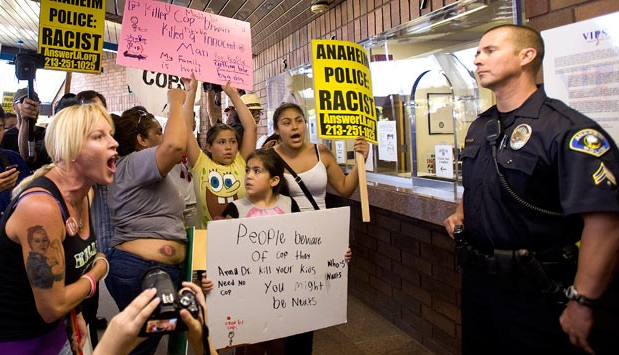
Such reactionary actions by police unions are not new, but are a fundamental component of their history, particularly since they came to prominence in the wake of the civil rights movement. These organizations have played a powerful role in defending the police, no matter how outrageous and racist their actions, and in resisting all manner of police reforms.

New York

In June 1966, New York City Mayor John Lindsay, responding to widespread complaints of police brutality, called for a civilian review board. Five thousand off duty NYPD cops rallied at City Hall in opposition, and the head of the PBA, leading the campaign against civilian review, intoned that “I am sick and tired of giving in to minority groups, with their whims and their gripes and shouting. Any review board with civilians on it is detrimental to the operations of the police department.” Invoking the specter of increased crime, the PBA mounted a massive public relations campaign against the measure, and it was defeated in a referendum that year.

In 1975, in response to proposed budget cuts that included police layoffs, the PBA ordered a rampage through the city’s black and Puerto Rican communities, with thousands of off duty cops waving their guns, banging on trash cans, and blowing whistles for several nights until Mayor Abe Beame obtained a restraining order.

Ten years later, after Mayor Ed Koch revived the issue of civilian review in the wake of a white cop killing Eleanor Bumpurs, an elderly and mentally ill black woman, the PBA again condemned the idea, staged a work slowdown in response to the attempted prosecution of the officer, Stephen Sullivan, and pressured Koch into reinstating Sullivan even though he had been criminally charged with the killing.

In 1992, when David Dinkins, the first (and only) African-American Mayor of New York City sought to implement a civilian review agency to investigate allegations of police misconduct, the PBA organized another City Hall rally in protest. This time, the crowd of officers numbered 10,000, with PBA members hurtling barricades, jumping on cars, blocking the Brooklyn Bridge and kicking a reporter. Some of the rally’s participants carried signs showing Dinkins with a bushy Afro haircut and swollen lips, with racist slogans, including ones that ridiculed him as a “washroom attendant.”

In the mid-1990s, the independent Mollen Commission, appointed by Mayor Dinkins to investigate police corruption, documented widespread police perjury, brutality, drug dealing and theft in the NYPD, and found that “by advising its members against cooperating with law-enforcement authorities, the P.B.A. often acts as a shelter for and protector of the corrupt cop." These findings were seconded by senior NYPD officials and prosecutors who were quoted by the New York Times as saying that they would continue to “have trouble rooting out substantial numbers of corrupt officers as long as the P.B.A. resists them."

The Times further quoted these officials as complaining that the PBA, “fortified with millions of dollars in annual dues collections . . . is one of the most powerful unions in the city. As an active lobbyist in Albany and as a contributor to political campaigns, the P.B.A. has enormous influence over the department and is typically brought in for consultations before important management decisions are made."

In the Abner Louima case, the PBA’s role extended beyond reactionary advocacy and agitation to active participation in a conspiracy to cover-up the brutal crimes of its members. In 1997, an NYPD officer sexually assaulted Louima in a Precinct Station bathroom by violently shoving a broken broomstick into his rectum. His attacker and three of his police accomplices were charged with criminal civil rights offenses.

Evidence in the criminal proceedings revealed that a PBA official had chaired an early meeting with the implicated officers, one of whom was a PBA delegate, at which they fabricated a false story designed to exonerate one of the conspirators. Even after the officers were convicted, the PBA continued to defend the officers, both publicly and with financial support, and to advocate for them with their fabricated version of events—with none other than Patrick Lynch claiming that “people with a political agenda have fanned the flames of this incident,” leading to an “innocent man  . . . being punished beyond belief.”

More recently, Lynch and the PBA, together with the NYPD sergeants and captains associations, after condemning Federal Judge Shira Scheindlin’s order that sharply limited the NYPD’s discriminatory stop and frisk policies, unsuccessfully sought to appeal her order after Mayor de Blasio made good on his campaign promise not to appeal.

And this past year, confronted with another indefensible case of NYPD violence, PBA President Lynch again went on the offensive. In August, after the medical examiner determined that Eric Garner’s death at the hands of officer Daniel Pantaleo was a homicide by means of a chokehold, Lynch declared that the examiner was “mistaken” in finding that the death was a homicide, and that he had “never seen a document that was more political than that press release by the [medical examiner].”

In a classic case of doubletalk, he further asserted that it was “not a chokehold. It was bringing a person to the ground the way we’re trained to do to place him under arrest." He chastised Mayor de Blasio for not “support[ing] New York City police officers unequivocally.”

In December, Lynch praised the Staten Island Grand Jury’s decision not to charge Panteleo, while accusing Garner of resisting arrest, brushing off two police misconduct lawsuits—one for sexual assault during a search— brought against Panteleo and idolizing him as “literally an Eagle Scout,” a “model” cop, and “mature, mature” officer.

And once again, the PBA unleashed a work slowdown in further protest of Mayor de Blasio that lasted several weeks.

Chicago

In Chicago, the Fraternal Order of Police, which represents CPD patrol officers, has a similarly notorious history.  (Continued)

Continue reading Blood On Their Hands: The Racist History of Modern Police Unions
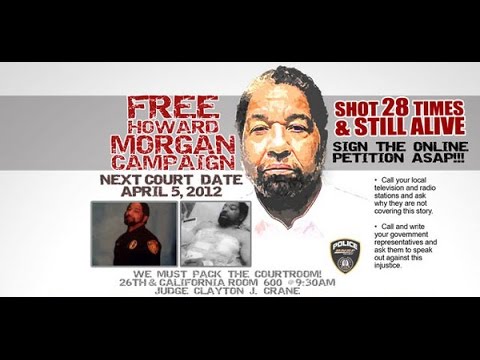
Howard Morgan Is Free – A Peoples Victory!

Outgoing Governor Pat Quinn Commutes Sentence, Gives Additional Pardons

National Alliance Against Racism and Political Repression – Chicago

We, along with tens of thousands of other people, greet the decision by former Governor Patrick Quinn to commute[i] the sentence of Howard Morgan, who was almost killed by Chicago Police on Feb. 21, 2005, and was charged with attempted murder.  Howard Morgan, himself a police officer for over 21 years, was charged and unlawfully convicted in a second trial after being acquitted of firing his weapon in the incident.  He was sentenced to 40 years in prison.

We also greet the pardon based on innocence granted by Gov. Quinn to David Bates, and the commutation of the sentences of Anthony Dansbery, Tyrone Hood, Willie Johnson, and Carlos Villareal.  All have suffered years in prison unjustly, often for crimes they did not commit.

These are victories of the peoples struggles for justice.  We also must recognize the honesty and the courage of Gov. Quinn to act in the face of injustice, injustice that was organized and mobilized by state prosecutors and the police.  Gov. Quinn, in his last act as governor, will join the ranks of John Peter Altgeld and George Ryan, Illinois governors who took giant steps in the face of tremendous opposition to “do the right thing.”

But let us have no illusions.  The courage and honesty of one man, Gov. Quinn, alone could not have done it.  Gov. Quinn’s great achievement is that he was able to see and to hear the upsurge of millions of people all across this nation, demanding an end to police crimes.  Millions have participated, and continue to participate, in marches,  protests, direct non-violent actions, demanding an end to police violence, starting in response to the murder of Michael Brown in Ferguson Missouri.  This movement, embracing all races and ethnic groups even while being sparked and led by African American youth, deserves the credit for forcing the issue of police crimes and the cases of Howard Morgan and the others to the forefront.

The slogan of the campaign for freedom for Howard Morgan has been “Now Justice has a Voice,” because unlike Michael Brown, Eric Garner, and thousands of African American, Latino, and some white people who have been killed by police violence, Howard Morgan survived.  He is now free.  His voice will be a powerful one for ending police crimes, for passage of laws establishing democratic civilian control of the police, such as that proposed by the Chicago Alliance Against Racist and Political Repression.

Howard Morgan, David Bates, Anthony Dansbery, Tyrone Hood, Willie Johnson, and Carlos Villareal are free, but scores of Black and Latino men who have been tortured and forced to falsely confess to crimes they did not commit remain in prison.  In the words of the late Amilcar Cabral, “A luta continua!”

The Urgent Question of Strategy And Tactics in Building Our Movement

By Frank Chapman

Chicago Alliance Against Racist and Political Repression

How are strategy and tactics determined in waging political struggle? In the historic social movements of the racially oppressed and the working class the question of strategy and tactics is always urgent. To understand why this is important we must look at the basic characteristics that define social movements.

For the purpose of this discussion let us characterize social movements as either spontaneous or organized. Spontaneous social movements arise out of the objective social relations (i.e. social savagery) of capitalism. Driven by profit and greed, the vulture capitalism perpetrated by the 1% creates untold misery and suffering for the masses of workers and oppressed communities of color. Widespread unemployment, poverty and racist and political repression create social unrest and spontaneous rebellion.

These rebellions arise independently of the conscious will of the people expressed through their various organizations such as unions, community based organizations, and organized grass roots political struggles. They have no strategy or tactics. Spontaneous uprisings cannot be stopped or started by organizations. They can be scientifically studied and taken into account in other ways, but they cannot be regulated or determined by subjective evaluation. Unconscious unplanned rebellion takes many forms, even in an uprising as we witnessed in Ferguson. No matter what form it takes, spontaneous rebellion is characteristically blind precisely because it is not guided by an aim or a strategy for liberation.

Social movements, on the other hand, become conscious when the people awaken to the need for organized struggle and resistance in fighting their oppressors. That is how social movements transition into conscious organized struggles. Our struggle for an elected Civilian Police Accountability Council (CPAC) represents the conscious, subjective side of the movement in that it is organizing towards a definite goal, the enactment of a law that will empower the people to hold the police accountable for the crimes they commit. This is organized struggle demanding a systemic change that will empower the people to hold the police accountable for the crimes they commit. We fight for power at this stage by making people aware of the systemic nature of the problem and then engaging them in a political struggle to change the system. In this phase of our movement the need for strategy and tactics is urgently clear.

Strategy is determined by scientifically assessing objective social conditions, the moral and political climate and the relationship of forces. The moral and political climate has been dramatically changed by the Ferguson uprising. When we say the police are the cutting edge of mass incarceration and political repression in oppressed communities we are talking about the relationship of forces. You have to be arrested and prosecuted before being sent to prison. Racist police repression, under the cover of draconian drug laws, diminishes the organizing space for people to fight for social and economic justice. We must also look at police repression of the Occupy movement and of the Peace and Solidarity movements. The police will be increasingly used to repress the trade union movement as it grows more militant in organizing the unorganized. We must also acknowledge the repressive role of the FBI and National Security police under the guise of fighting terrorism and keeping our borders safe.

Our strategic goal is community control of the police as it is spelled out in our proposed CPAC legislation. The principal tactic for achieving our goal is organizing a mass support base of voters and residents in those areas hardest hit by police crimes and to organize a mass march of 10,000 to converge on the Federal Building and City Hall August 29, 2015. We already have over 10,000 supporters and some 200 volunteers. Through petitioning, canvassing and reaching out to other community based organizations and movement organizations we believe we can have a total of 100,000 supporters by August 29, 2015 coming mainly out of those communities hardest hit by police crimes.

We believe that this is the most effective way politically and socially to address the distrust and long standing antagonism between oppressed communities of color and the police. The fight for a democratically elected Civilian Police Accountability Council has strategic importance to the overall fight for democracy in our country. Move this spoke, and we move the wheel.