Iowa Working Families Summit Advances Push for Progressive Agenda


By Emily Foster
Campaign for America’s Future

May 25, 2015 – While well-heeled conservatives watched Republican presidential candidates make their pitches for support in an Iowa convention hall at the GOP’s Lincoln Dinner on May 16, grassroots progressives gathered in a much less lavish college auditorium to discuss pressing issues for America’s struggling middle class.

The Iowa State Campus University in Ames, Iowa, was where people from more than 50 organizations (including co-sponsors of groups endorsing CAF’s Populism 2015 Platform) gathered for the Iowa Working Families Summit. The summit had a huge turnout of more than 600 people from all over the state. Their focus was on showing that progressive policies, such as investing in infrastructure, raising the minimum wage and strengthening labor unions, are the key path to American prosperity.

Larry Cohen, president of the Communications Workers of America and vice president of the AFL-CIO, elaborated on the cohesive ideas shared at the conference by the participating groups, and said he has never seen a “better statewide effort” to advance ideas important to American workers. He also explained how important it was for the groups to “get out of the silos and into the streets.”

“It’s not just about the choices of our candidates” Cohen said when asked about the impact of the conference on the 2016 elections. “It’s also about how we’re building our agenda for the middle class.”

The keynote speaker – Robert Reich, former U.S. Secretary of Labor (1993-1997) – noted that the U.S. economy has grown twice as large in the past 30 years, but wages for the middle class have gone “nowhere,” due to a political system that rewards the wealthiest Americans and corporations.

Essentially, we have an economy “that’s rigged against the average working people.”

Reich emphasized that Americans in the middle class need to “stand up together,” and rebuild the strength of the middle class through raising support for labor unions, education, and infrastructure.

Sue Dinsdale, executive director of the Iowa Citizen Action Network, said her organization plans to build on the ideas considered at this past weekend’s summit. Throughout the upcoming election cycle, the organization plans to “take the summit on the road – take ideas out into communities and towns throughout Iowa, and to organize similar events.”

Continue reading Iowa Working Families Summit Advances Push for Progressive Agenda

David Bacon–Streets of New York: work or no work

A David Bacon photoessay on life and work on the streets of New York


© David Bacon, 2015

Click on the photo to go to the entire essay

From Chinatown to midtown, Manhattan is part of a city that works, and also that doesn’t work. That is, it’s full of working people, but not everyone has a job. Some people work on the street, while others live and sleep on it. New York is not like the suburbs, or cities built around malls and cars. Everything and anything can happen in the streets here.

More…

The Great Democratic Crack-Up of 2016

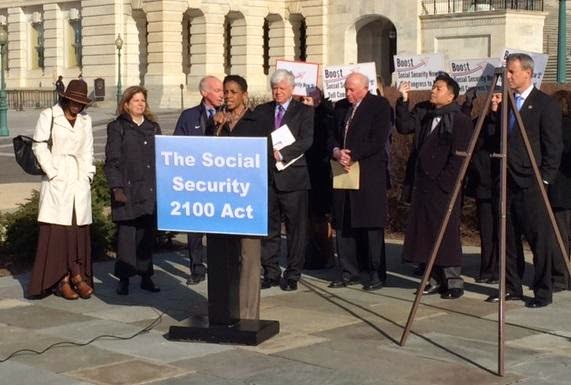
Rep. Edwards speaking to defend and expand Social Security

They may have a strong presidential candidate, but at every other level, the party’s politicians and activists are fighting to survive — and fighting with one another.

By ROBERT DRAPER
New York Times Magazine

MAY 12, 2015 – Maryland might seem a peculiar venue for a blood feud over the future of the Democratic Party. It is the second-bluest state in the United States, after Massachusetts, according to Gallup; its registered Democrats, more than 30 percent of whom are black, outnumber registered Republicans two to one. Maryland is home to an immense federal work force and is one of the states most economically dependent on the federal government. Its gun-control laws are among the strictest in the nation. In 2012, Maryland and Maine became the first states to ratify same-sex marriage by popular vote. Barack Obama’s statewide margin of victory was roughly 26 points in 2008 and 2012, the fifth highest in the United States. The last time the G.O.P. won control of the Maryland State Legislature was in 1897. So reliable is its party affiliation that, as a Democratic senator’s chief of staff puts it, “If Maryland ever becomes a jeopardy state, then the whole thing is gone.”
Continue reading the main story

This past March, when Barbara Mikulski, the longest-serving woman in United States Senate history, unexpectedly announced that she would not be seeking a sixth term in 2016, national progressive groups quickly threw their weight behind their dream candidate: Donna Edwards. A pugnacious former community organizer, Edwards is a four-term African-American congresswoman from Prince George’s County, one of the most affluent majority-black counties in the United States. But she wasn’t the favorite of establishment Democrats.

For them, the obvious choice to replace Mikulski was the seven-term congressman Chris Van Hollen, who is considered a progressive like Edwards, but has a reputation for coolheaded practicality and for working well with Republicans. Of the bills sponsored by Van Hollen in the previous session of Congress, 37 percent included at least one Republican co-sponsor. For Edwards, the corresponding figure was 0 percent. Where she is viewed as a warrior for liberal causes, he is seen as a conciliator, one whose let’s-sit-down-and-talk-this-over geniality led to his tenure as chairman of the Democratic Congressional Campaign Committee from 2007 to 2011 and, thereafter, to his designation as the House Democrats’ point man on bipartisan budget discussions. As their lead negotiator, Van Hollen has immersed himself in the sort of legislative sausage-making that typically entails compromise, like his expressed willingness, in 2012, to consider restructuring Social Security as part of an overall deficit-reduction agreement. To progressives, this was nothing less than apostasy.

Though the Senate Democratic primary was a year away, the national groups supporting Edwards knew that Van Hollen would be viewed as the prohibitive front-runner if they didn’t define the stakes of the contest immediately. Three of these groups — the Progressive Change Campaign Committee, Democracy for America and Blue America — sent out a blizzard of fund-raising solicitations, petitions and emails to members and to the media, one of which hailed Edwards as “a true Elizabeth Warren Democrat,” referring to the U.S. senator from Massachusetts whose confrontational stances on economic issues have galvanized the left. Van Hollen received an altogether different reception. Within hours after he made his candidacy official on March 4, three other voices from the liberal wing of the party — MoveOn, Credo Action and Daily Kos, the website run by the activist Markos Moulitsas — openly questioned his progressive bona fides and implied that he was one of a breed of “corporate ‘New Democrats.’?” Moulitsas’s website declared that Van Hollen’s flexibility on Social Security amounted to “a major red flag,” making him “a candidate that may bargain away retirement security.” Edwards, meanwhile, entered the race pointedly pledging never to tamper with Social Security, “no ifs, ands, buts or willing-to-considers.”

Whichever Democratic candidate wins the primary next spring, he or she will be heavily favored to become the state’s next U.S. senator. Because of this, the Maryland contest is unlikely to hinge on which candidate can appeal to the broadest spectrum of voters on Election Day. Rather, it will be a fight over what a true Democrat should, and should not, be.  (Continued)

Continue reading The Great Democratic Crack-Up of 2016